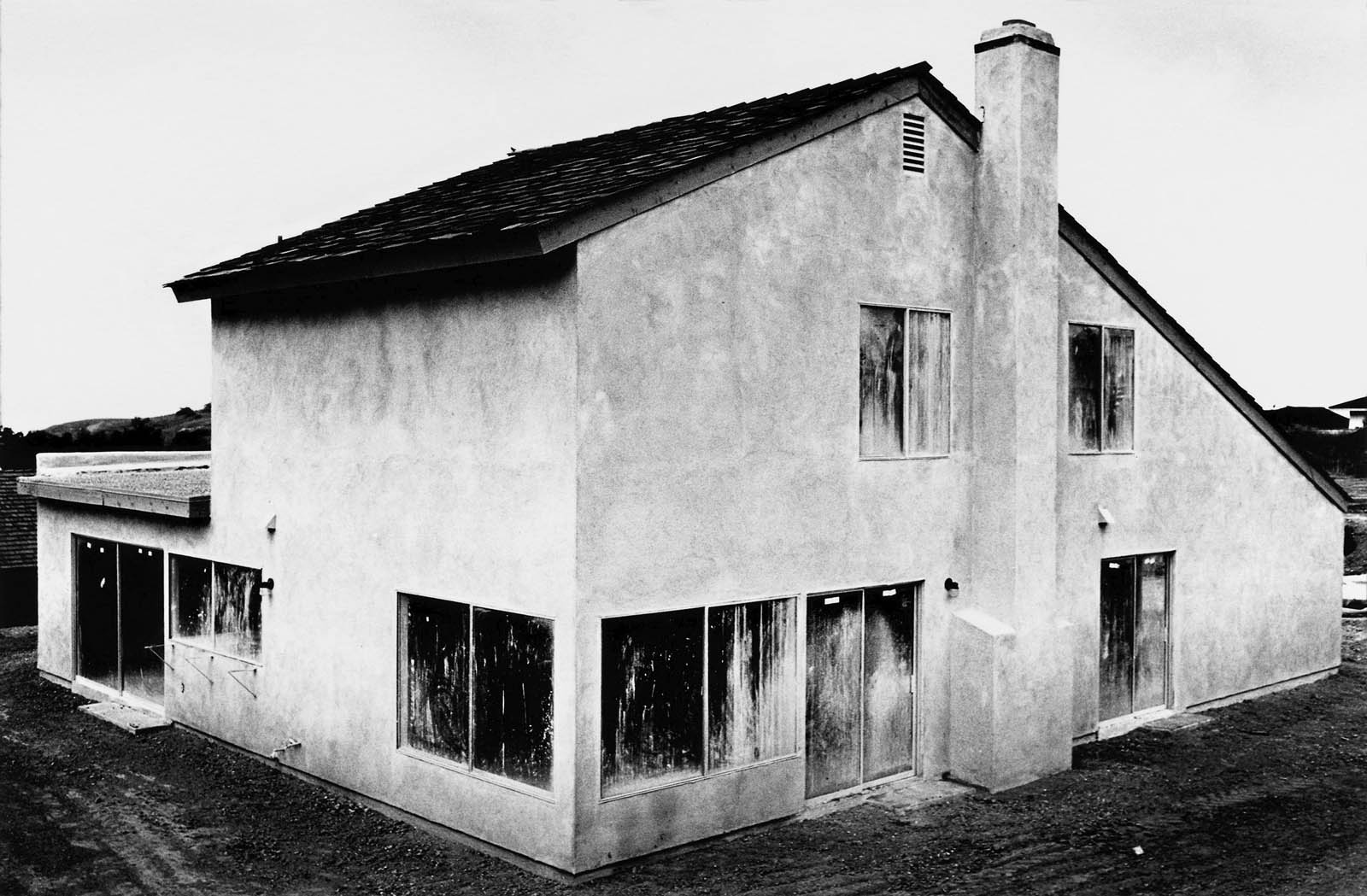
New Topographics: Photographs of a Man-Altered Landscape opened in October 1975 at the International Museum of Photography at George Eastman House in Rochester, New York. Curated by William Jenkins, the exhibition brought together the work of ten photographers — Robert Adams, Lewis Baltz, Bernd and Hilla Becher, Joe Deal, Frank Gohlke, Nicholas Nixon, John Schott, Stephen Shore, and Henry Wessel Jr. — whose shared subject was the contemporary American landscape as shaped, scarred, and transformed by human activity.
The exhibition marked a decisive rupture with the tradition of sublime landscape photography that had dominated the American medium since the nineteenth century. Where Ansel Adams and his predecessors had sought out the pristine wilderness, framing nature as a cathedral of untouched grandeur, the New Topographics photographers turned their cameras on the unremarkable, the ordinary, the overlooked: tract housing developments spreading across the Colorado Front Range, parking lots and gas stations baking in the California sun, warehouse façades in industrial parks, intersections in small towns. Their images were characterised by a cool, descriptive detachment — what Jenkins called a stylistic anonymity — that refused the emotional drama of the Romantic landscape tradition.
The intellectual roots of the exhibition lay in several converging developments. The Bechers’ systematic typological catalogues of industrial structures — water towers, blast furnaces, winding towers, gas tanks — pioneered since the late 1950s at the Düsseldorf Academy, provided a rigorous European model of documentary photography stripped of subjective expression. In America, the deadpan aesthetic of Ed Ruscha’s artist books, particularly Twentysix Gasoline Stations (1963) and Every Building on the Sunset Strip (1966), had demonstrated that the vernacular built environment could be treated as a legitimate subject for sustained artistic attention. And the growing environmental consciousness of the early 1970s gave political urgency to images that made visible the relentless sprawl of suburban development.
Robert Adams’ contribution was perhaps the exhibition’s moral centre. His photographs of new housing tracts, mobile homes, and commercial strips along the Colorado Front Range were suffused with a quiet ambivalence — a recognition that this landscape, however aesthetically diminished, was the place where millions of Americans actually lived, and that it deserved the same careful attention that earlier photographers had lavished on Yosemite or the Grand Canyon. His work demonstrated that beauty and banality could coexist, and that the documentary impulse need not preclude a deeply felt response to place.
Lewis Baltz brought an almost sculptural precision to his photographs of new construction sites, industrial parks, and the raw, unfinished edges of suburban development. His series The New Industrial Parks near Irvine, California (1974) and the later Park City (1980) treated the American commercial landscape as a kind of minimalist abstraction, finding unexpected formal elegance in the repetitive geometries of tract housing and warehouse façades. Baltz described his subjects as the architecture of the majority, and his cool, analytical gaze became a defining characteristic of the New Topographics sensibility.
Stephen Shore, the youngest participant, brought a different sensibility to the group. Working in large-format colour — unusual at a time when serious art photography was predominantly black and white — his images of American intersections, motels, and main streets possessed a luminous clarity that transformed the mundane into something approaching the visionary. His ongoing project Uncommon Places, begun in 1973, became one of the most influential bodies of work in the history of colour photography and demonstrated that the New Topographics approach could encompass warmth and even wonder alongside documentary rigour.
At the time of its opening, the exhibition attracted relatively modest attention. The photographs were criticised in some quarters as boring, as mere documentation devoid of artistic ambition. But in the decades since, New Topographics has come to be recognised as one of the most consequential exhibitions in the history of photography. Its influence pervades contemporary landscape and architectural photography, from the monumental industrial surveys of Edward Burtynsky to the suburban studies of Joel Sternfeld and the typological work of the Bechers’ students — Andreas Gursky, Thomas Struth, Thomas Ruff, and Candida Höfer — who became the most commercially successful photographers of the late twentieth century. The exhibition established the built environment as a primary subject for photographic art, and its legacy continues to shape how we see and interpret the landscape around us.