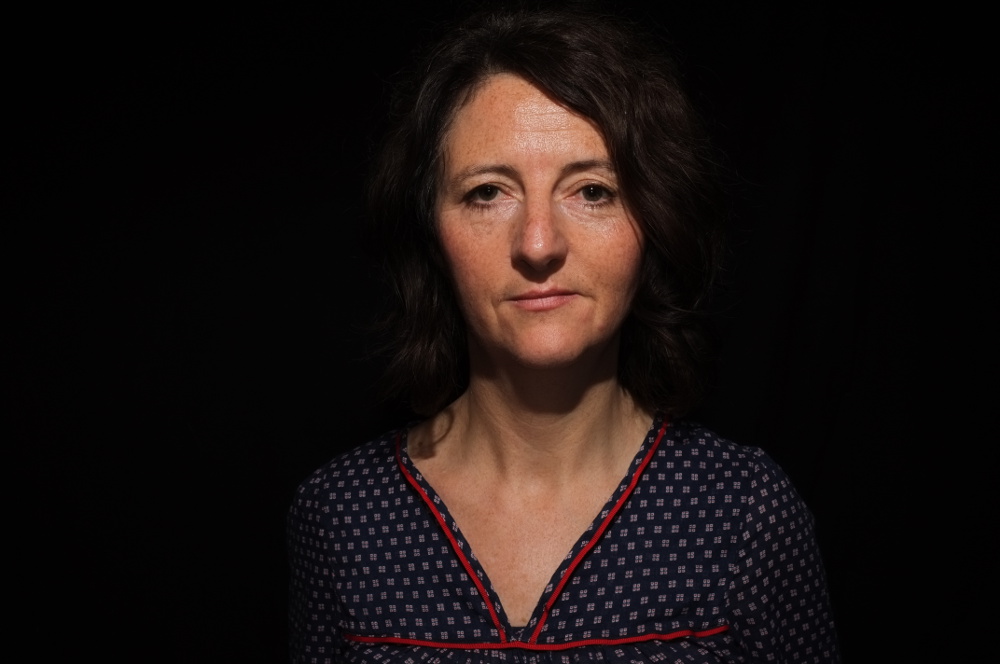
Trish Morrissey, Bristol Photobook Festival
Photo: Pete M. Boyd, 2014 · CC BY-SA 4.0
An Irish artist whose performative, large-format photographs explore identity, family, femininity, and belonging, inserting herself into the lives of strangers and the imagery of domestic ritual to question who we are and how we construct our roles within the family unit.
Born 1967, Dublin, Ireland — Irish
Trish Morrissey, Bristol Photobook Festival
Photo: Pete M. Boyd, 2014 · CC BY-SA 4.0
Trish Morrissey was born in Dublin in 1967 and grew up in a large Irish family whose rituals, hierarchies, and dynamics would become the central subject of her artistic practice. She studied fine art at the Dublin Institute of Technology and later completed an MA in Fine Art at the Chelsea College of Art and Design in London, where she settled. Her work, which spans photography, video, and performance, is rooted in an investigation of identity, belonging, and the roles that individuals assume — or are assigned — within family structures. She is one of the most distinctive and intellectually rigorous artists to have emerged from the Irish diaspora, and her photographs, which are always meticulously staged and often feature the artist herself as a performer, occupy a charged space between documentary and fiction, between the personal and the universal.
Morrissey's breakthrough body of work, Seven Years (2001–2004), drew directly on her experience as one of seven siblings in an Irish Catholic family. The series consists of large-format colour photographs that restage moments from the Morrissey family's domestic history, drawing on the vernacular imagery of family snapshots — birthday parties, Christmas mornings, holidays, and the ordinary gatherings of childhood. But in each image, the artist and her sister swap roles, Trish taking her sister's place and vice versa, creating a subtle but unsettling disruption of the family narrative. The photographs are meticulously produced, reproducing the colours, fashions, furniture, and visual texture of specific decades from the 1960s to the 1980s, and their power lies in the tension between the apparent authenticity of the family scene and the knowledge that identities have been exchanged, that the roles we play within our families are not fixed but fluid, performative, and potentially interchangeable.
The project that brought Morrissey to wider international attention was Front Door Portraits (2005–2009), a series in which the artist approached strangers on beaches in England, Australia, and elsewhere, asked to take their place within their family group, and then had herself photographed as a temporary member of the family. In each image, Morrissey assumes the position and clothing of one of the family members — typically the mother — while the displaced person takes the photograph. The resulting images are funny, poignant, and deeply strange. Morrissey, who is invariably recognisable as an outsider despite her efforts to blend in, exposes the conventions of the family snapshot — the poses, the groupings, the ritualistic displays of togetherness — while simultaneously revealing how fragile and constructed the notion of family belonging actually is.
Front Door Portraits operates on multiple levels. As social experiment, it tests the willingness of strangers to accept an interloper into their most intimate grouping. As performance art, it explores the act of assuming another person's identity and the uncanny sensation of occupying someone else's place. As photography, it interrogates the conventions of the vernacular family portrait and the gap between what such images claim to show — unity, happiness, belonging — and the more complex realities they conceal. The series has been widely exhibited and discussed, and it has become one of the most referenced works in contemporary debates about photography, performance, and the construction of identity.
In subsequent projects, Morrissey has continued to explore the relationship between identity, performance, and the photographic image. Rose (2004) is a series of self-portraits in which the artist dresses in her late grandmother's clothes and assumes poses drawn from the older woman's photograph albums, collapsing the boundary between generations and exploring the transmission of identity across family lines. Her video works, including How We Used to March and That Shining Hour, extend these concerns into the moving image, using performance and restaging to investigate the relationship between personal memory, collective history, and the visual archives through which families construct their narratives.
Morrissey's work has been exhibited internationally at institutions including the Photographers' Gallery in London, the Irish Museum of Modern Art, the Hasselblad Center in Gothenburg, the National Portrait Gallery in London, and the Museum of Contemporary Photography in Chicago. She has been shortlisted for the Citibank Photography Prize and has received numerous arts council awards. Her photographs are held in collections including the Victoria and Albert Museum, the Arts Council of England, and the Irish Museum of Modern Art.
Based in London, Morrissey continues to produce work that challenges the boundaries between photography and performance, between self and other, and between the fixed identities we present to the world and the fluid, contingent selves that actually inhabit our bodies. Her practice asks a deceptively simple question — who are we within our families, and could we be someone else? — and answers it with images that are at once humorous, disquieting, and profoundly moving.
I am interested in the gap between the way things look and the way things are, between appearance and reality. Trish Morrissey
A performative series in which Morrissey approaches strangers on beaches, assumes the place of one family member, and is photographed as a temporary member of the group, interrogating the conventions of the family portrait and the construction of belonging.
Restaged family snapshots from the Morrissey household in which the artist and her sister swap identities, exploring the fluidity of family roles and the gap between the stability that family photographs claim and the complexity they conceal.
Self-portraits in which Morrissey wears her late grandmother's clothes and assumes her poses, collapsing the generational boundary and exploring the transmission of identity, memory, and femininity across family lines.
Born in Dublin, Ireland. Grows up as one of seven siblings in an Irish Catholic family.
Studies fine art at the Dublin Institute of Technology and completes an MA at Chelsea College of Art and Design, London.
Begins Seven Years, a series of restaged family photographs in which she and her sister exchange identities within recreated domestic scenes.
Produces Rose, self-portraits in her late grandmother's clothes, and completes the Seven Years series.
Begins Front Door Portraits, approaching strangers on beaches and inserting herself into their family groups for staged photographs.
Shortlisted for the Citibank Photography Prize. Exhibits at the Photographers' Gallery, London.
Completes the Front Door Portraits series after producing images on beaches in England, Australia, and other locations.
Continues to work from London, producing photography, video, and performance works that explore identity, family, and the gap between appearance and reality.
Interested in discussing photography, collaboration, or just want to say hello? I’d love to hear from you.
Contact →