Thomas Ruff was born in 1958 in the small town of Zell am Harmersbach in the Black Forest region of southwestern Germany. He grew up in a rural landscape of extraordinary visual quietness, a backdrop that would make the cool, analytical rigour of his later work all the more striking. In 1977, he enrolled at the Kunstakademie Düsseldorf, where he studied under Bernd and Hilla Becher, the legendary husband-and-wife team whose typological studies of industrial architecture had established a new paradigm for conceptual photography. Alongside classmates Thomas Struth, Andreas Gursky, and Candida Höfer, Ruff became part of what would be recognised as one of the most influential cohorts in the history of the medium — the Düsseldorf School.
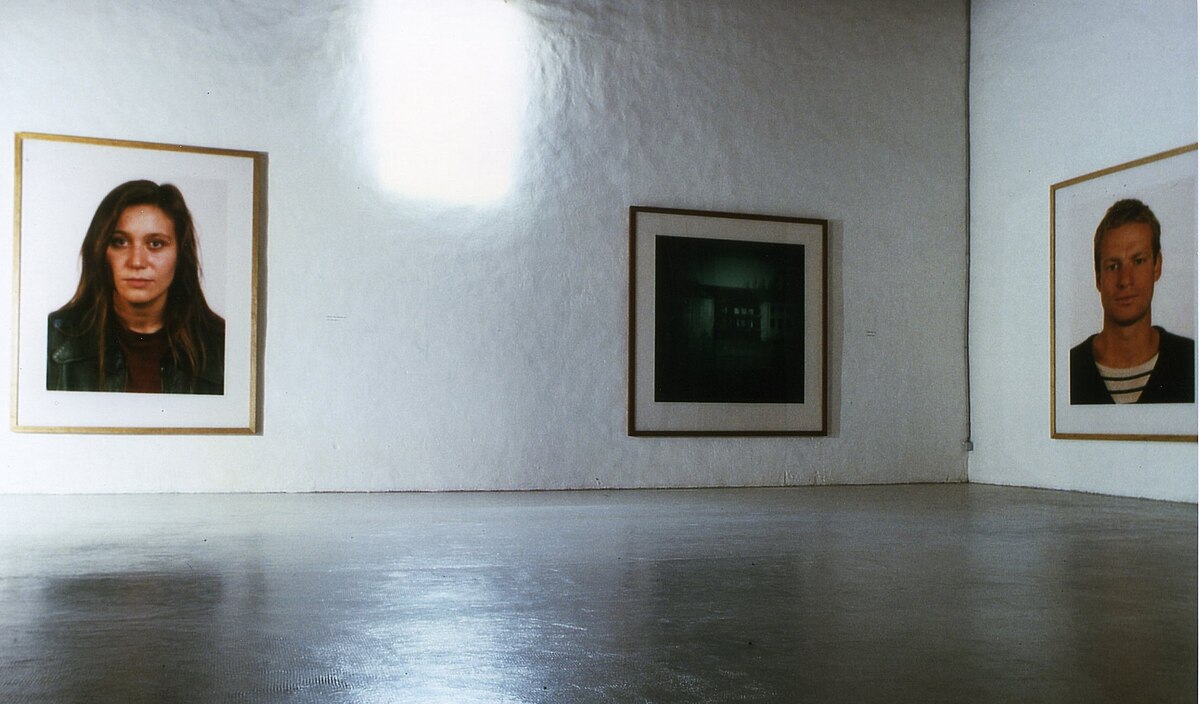
Ruff's earliest significant body of work, the Interieurs (1979–1983), consisted of colour photographs of domestic interiors — living rooms, kitchens, hallways — rendered with a deadpan objectivity that owed much to the Bechers' methodology. But it was his Porträts series, begun in 1981 and expanded dramatically from 1986, that brought him to international prominence. These monumental, passport-style head shots of young men and women, printed at a scale of over two metres high, stripped the photographic portrait of all expressive and narrative content. The subjects gazed directly at the camera with neutral expressions, lit evenly against blank backgrounds. Enlarged to such dimensions, these faces became simultaneously more present and more abstract, their surfaces revealing every pore and blemish while yielding nothing of the sitter's inner life. The portraits posed a devastating question: what, if anything, does a photographic likeness actually tell us about a person?
Throughout the 1990s, Ruff embarked on a series of projects that progressively expanded his investigation of photographic representation. The Sterne (Stars) series, begun in 1989, used negatives obtained from the European Southern Observatory to produce large-format prints of the night sky — images Ruff had not taken himself but which he claimed as his own through the acts of selection, cropping, and printing. The Häuser (Houses) series documented postwar German architecture with the same frontal rigour the Bechers had applied to industrial structures. The Nachten (Nights) series employed night-vision technology to produce eerie, green-tinged images of suburban buildings, appropriating the visual language of military surveillance and television news coverage of the Gulf War.
The turn of the millennium saw Ruff move decisively into digital manipulation, a shift that many critics regarded as his most radical contribution to contemporary photography. The Nudes series (1999–ongoing) took pornographic images downloaded from the internet and subjected them to extreme digital blurring and colour saturation, transforming explicit material into soft, painterly abstractions that evoked the sensuality of Impressionist painting while raising urgent questions about the circulation of images in the digital age. The Substrates series (2001–ongoing) pushed this logic further, compressing and distorting images from Japanese manga and anime into shimmering, abstract fields of colour that hovered between figuration and pure pattern.
Perhaps the most widely discussed of Ruff's digital projects was the jpegs series (2004–ongoing), which took found images — including press photographs of the September 11 attacks, natural disasters, and tourist landscapes — and enlarged them to monumental scale, rendering visible the grid of compression artefacts that constitutes the hidden structure of every digital image. Blown up to two metres wide, the familiar photographs dissolved into mosaic-like blocks of colour, their content becoming almost unreadable even as it remained hauntingly recognisable. The series was a meditation on the material reality of the digital image, on the gap between what we think we see and the algorithmic processes that construct our visual world.
Ruff's work has been the subject of major retrospectives at institutions including the Kunsthalle Düsseldorf, the Haus der Kunst in Munich, the Whitechapel Gallery in London, and the Gagosian Gallery internationally. His photographs are held in the collections of the Museum of Modern Art in New York, the Centre Pompidou in Paris, the Tate Modern in London, and virtually every major museum of contemporary art worldwide. He has received numerous awards, including the International Center of Photography Infinity Award.
Ruff continues to live and work in Düsseldorf, where he remains a central figure in the ongoing interrogation of photography's relationship to truth, representation, and the conditions of seeing. Each new series he undertakes begins from a different premise and employs a different strategy, yet all are united by a single, relentless question: what is a photograph, and what can it actually show us? In posing this question with such systematic rigour across four decades, Ruff has done more than perhaps any other living artist to reveal the assumptions, conventions, and hidden structures that govern our relationship to the photographic image.