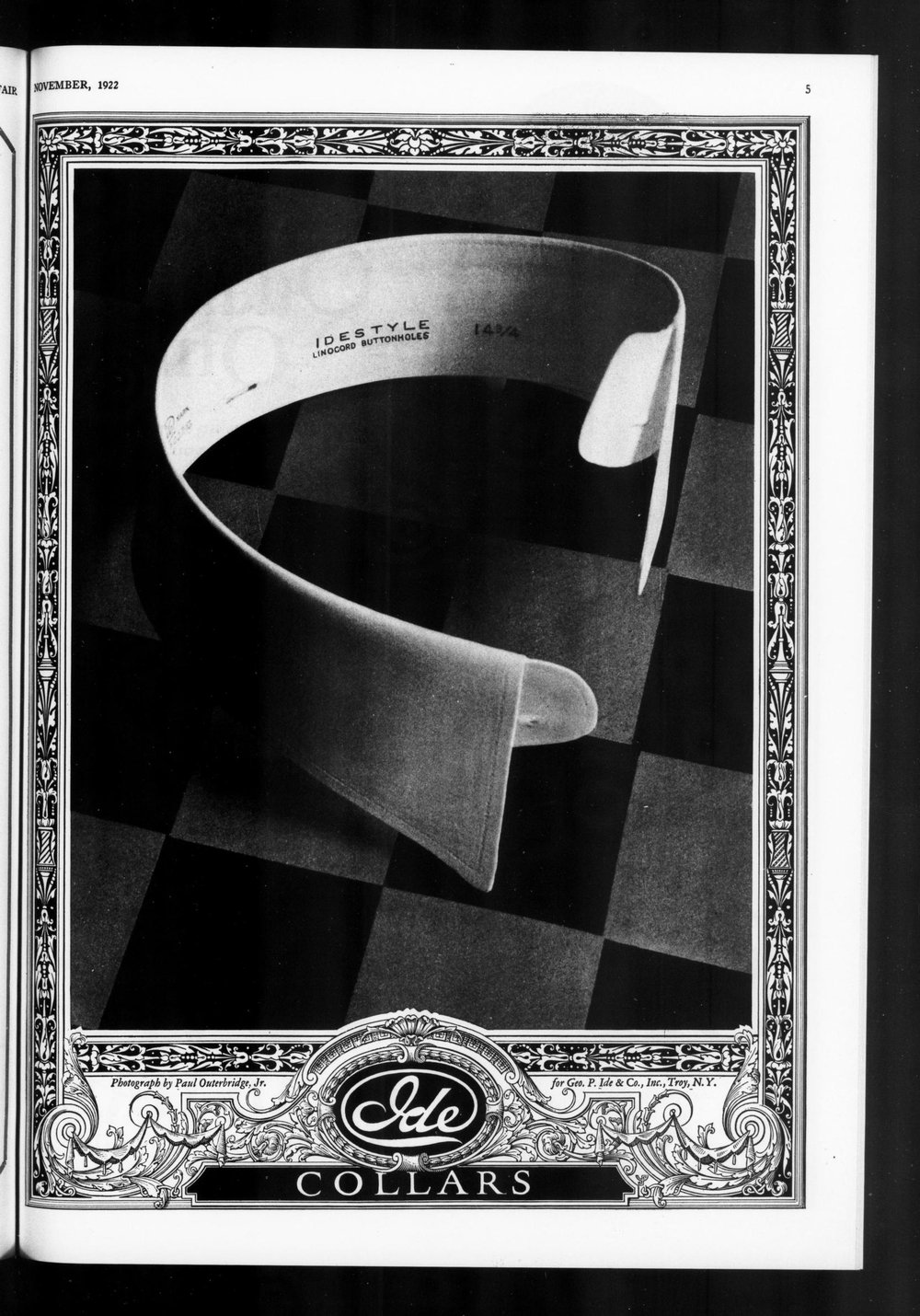
Ide Collar
Vanity Fair advertisement, 1922 • Public domain
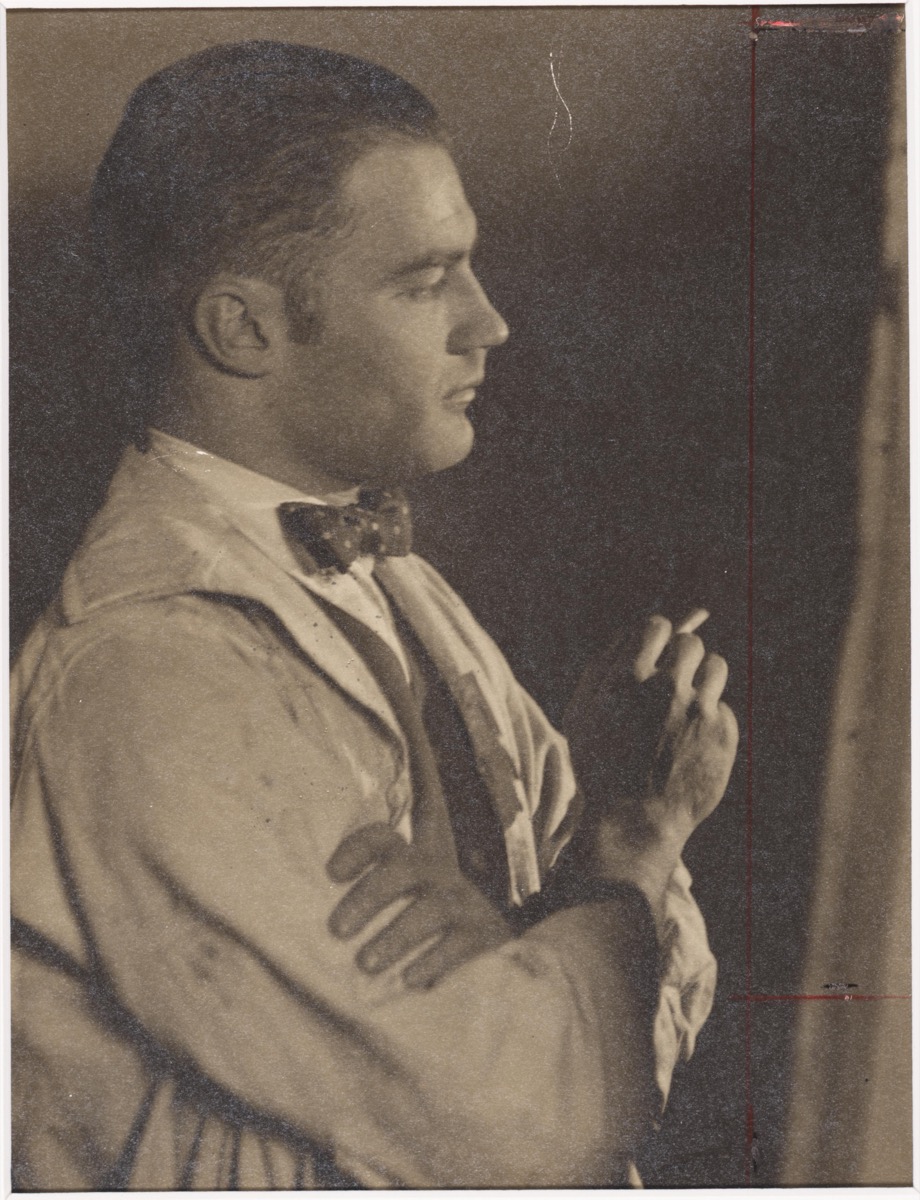
Henry Ernest Schnakenberg
Gelatin silver print, 1923 • Smithsonian Institution
A virtuoso of colour and form whose exquisitely crafted carbro prints and modernist still lifes elevated commercial photography to the realm of fine art, while his nude studies tested the boundaries of acceptability in mid-century America.
1896, New York City – 1958, Laguna Beach, California — American
Ide Collar
Vanity Fair advertisement, 1922 • Public domain
Henry Ernest Schnakenberg
Gelatin silver print, 1923 • Smithsonian Institution
Paul Outerbridge was born in 1896 in New York City, into a family of comfortable means that encouraged his early interest in art and design. He studied at the Art Students League of New York and served briefly in the Canadian Royal Flying Corps and the United States Army during the First World War. Upon returning to civilian life, he enrolled at the Clarence H. White School of Photography in 1921, a decision that would prove transformative. White, himself a distinguished pictorialist photographer, ran a programme that emphasised the principles of design — balance, composition, the interplay of light and shadow — and Outerbridge absorbed these lessons with extraordinary facility. Within a year of enrolling, he had produced work of such sophistication that it caught the attention of the commercial and fine art worlds simultaneously.
His earliest photographs, made as student exercises at the White School, are already remarkable. The celebrated Ide Collar of 1922, a platinum print depicting a man's detachable shirt collar resting on a checkerboard surface, became one of the most reproduced photographs of the decade. Its geometric precision, its play of light across intersecting planes, and its transformation of a mundane commercial object into an object of formal beauty aligned Outerbridge with the broader modernist project that was reshaping painting, sculpture, and architecture. The image was published in Vanity Fair and exhibited at galleries in New York and Paris, establishing Outerbridge's reputation while he was still a student.
Through the 1920s, Outerbridge built a highly successful career as a commercial photographer, producing work for Vanity Fair, Vogue, Harper's Bazaar, and numerous advertising clients. He moved to Paris in 1925 and spent four years immersed in the European avant-garde, befriending Marcel Duchamp, Man Ray, and Francis Picabia. He exhibited at the Salon de l'Escalier and contributed photographs to surrealist publications. The Parisian years deepened his understanding of the relationship between art and commerce, and confirmed his conviction that a photograph made for a magazine advertisement could possess the same formal rigour and aesthetic intensity as a photograph made for a gallery wall.
It was upon his return to New York in 1929 that Outerbridge began the work for which he is most celebrated: his mastery of the carbro colour print process. The carbro process, which involved transferring pigmented gelatin layers onto paper to produce full-colour images of extraordinary richness and permanence, was fiendishly difficult to execute. Each print required the precise registration of three separate colour layers — cyan, magenta, and yellow — and the slightest misalignment could ruin hours of work. Outerbridge mastered the technique with an obsessive perfectionism, producing colour photographs of a luminosity and depth that no other process of the era could match.
His carbro still lifes of the 1930s are among the finest colour photographs ever made. Arrangements of fruit, glassware, fabrics, and domestic objects were composed with a painter's eye for colour harmony and a sculptor's sense of volume, then rendered in colours so saturated and precise that they seem to glow from within. These images blurred the boundary between commercial illustration and fine art in ways that anticipated the pop art movement by three decades. Outerbridge understood, long before Andy Warhol, that the visual language of advertising was not the enemy of art but one of its most potent raw materials.
Alongside his commercial and still-life work, Outerbridge pursued a more private and controversial practice: the photographing of the nude female figure. His nude studies, many of them made as carbro prints, were artistically ambitious and frankly sensual, combining the formal precision of his still lifes with an erotic charge that made them unpublishable in the America of the 1930s and 1940s. Some of these images explored fetishistic themes that placed Outerbridge far ahead of his time, anticipating the work of Helmut Newton and Robert Mapplethorpe by half a century. The nudes were exhibited in Paris but were largely suppressed in the United States during his lifetime.
In 1940, Outerbridge published Photographing in Color, a technical treatise on colour photography that doubled as a statement of aesthetic philosophy. The book demonstrated his mastery of the carbro process while arguing passionately for colour as a medium worthy of the most serious artistic ambition. It remained the definitive work on colour photography technique for years after its publication.
Outerbridge spent his later years in Laguna Beach, California, where he continued to photograph but increasingly turned to writing and teaching. He died in 1958, largely forgotten by the art world. It was not until the 1970s and 1980s, when a new generation of curators and scholars began re-evaluating the history of colour photography, that Outerbridge's achievement was fully recognised. Today his carbro prints are held in the collections of the Metropolitan Museum of Art, the Museum of Modern Art, the J. Paul Getty Museum, and the Smithsonian, and he is acknowledged as one of the great pioneers of colour photography and modernist still-life composition.
One very important difference between color and monochromatic photography is this: in black and white you suggest; in color you state. Much can be implied by suggestion, but statement demands certainty. Paul Outerbridge
A single platinum print of a detachable shirt collar on a checkerboard surface that became an icon of modernist photography, transforming a commercial object into a study of pure geometric form.
A body of exquisitely crafted colour still-life photographs using the carbro process, producing images of unmatched luminosity that elevated commercial objects to the status of fine art.
A landmark technical treatise and aesthetic manifesto that codified Outerbridge's mastery of the carbro process and argued for colour photography as a serious artistic medium.
Born in New York City. Studies at the Art Students League before serving in the First World War.
Enrols at the Clarence H. White School of Photography, where he absorbs the principles of modernist design and composition.
Produces the Ide Collar, which is published in Vanity Fair and establishes his reputation as a major new talent.
Moves to Paris, befriends Marcel Duchamp and Man Ray, and exhibits alongside the European avant-garde.
Returns to New York and begins mastering the carbro colour print process, producing still lifes of extraordinary richness.
Produces his finest carbro colour work, including iconic still lifes and controversial nude studies exhibited in Paris.
Publishes Photographing in Color, the definitive technical and aesthetic guide to colour photography of its era.
Dies in Laguna Beach, California. His work is rediscovered and celebrated by a new generation of scholars in the 1970s and 1980s.
Interested in discussing photography, collaboration, or just want to say hello? I’d love to hear from you.
Contact →