Otto Steinert was born in 1915 in Saarbrücken, in the Saar region of Germany that would change national sovereignty several times during his lifetime. He studied medicine at the universities of Munich, Marburg, and Berlin, qualifying as a physician in 1939, and served as a military doctor during the Second World War. But photography had been his passion since adolescence, and when the war ended he abandoned medicine entirely, devoting himself to the camera with the same intellectual rigour he had brought to his medical studies. This combination of scientific training and artistic ambition would prove central to the movement he founded.
In 1948, Steinert was appointed head of the photography department at the Staatliche Schule für Kunst und Handwerk in Saarbrücken, a position that gave him both a platform and an audience for his ideas about what photography could and should be. The German photographic establishment of the late 1940s was dominated by two traditions that Steinert found equally unsatisfying: the sentimental pictorialism of the camera clubs, with their soft-focus landscapes and idealised nudes, and the objective reportage of the illustrated press, which treated the photograph as a transparent window onto reality. Steinert believed that both approaches denied photography its essential nature as a medium of personal expression.
In 1951, Steinert organised the first Subjektive Fotografie exhibition in Saarbrücken, bringing together work by photographers from across Europe and beyond who shared his conviction that the photograph should be understood not as a mechanical reproduction of the visible world but as a creative interpretation of it. The exhibition and its accompanying catalogue laid out the theoretical foundations of the movement: the photographer was an artist, not a technician; the camera was an instrument of vision, not merely of recording; and the full range of photographic techniques — solarisation, negative printing, multiple exposure, high contrast, extreme cropping, photograms, and luminograms — were legitimate tools of artistic expression, not tricks or gimmicks.
The first Subjektive Fotografie exhibition was followed by a second in 1954 and a third in 1958, each expanding the international reach of the movement and refining its theoretical programme. Steinert was both curator and leading practitioner, and his own images served as exemplary demonstrations of his principles. His Pedestrian's Foot (1950), a dramatically cropped and high-contrast image of a single shoe and its shadow on wet pavement, became an icon of the movement — a photograph that transforms an utterly ordinary subject into an image of formal power and psychological suggestiveness through the photographer's decisions about framing, exposure, and printing.
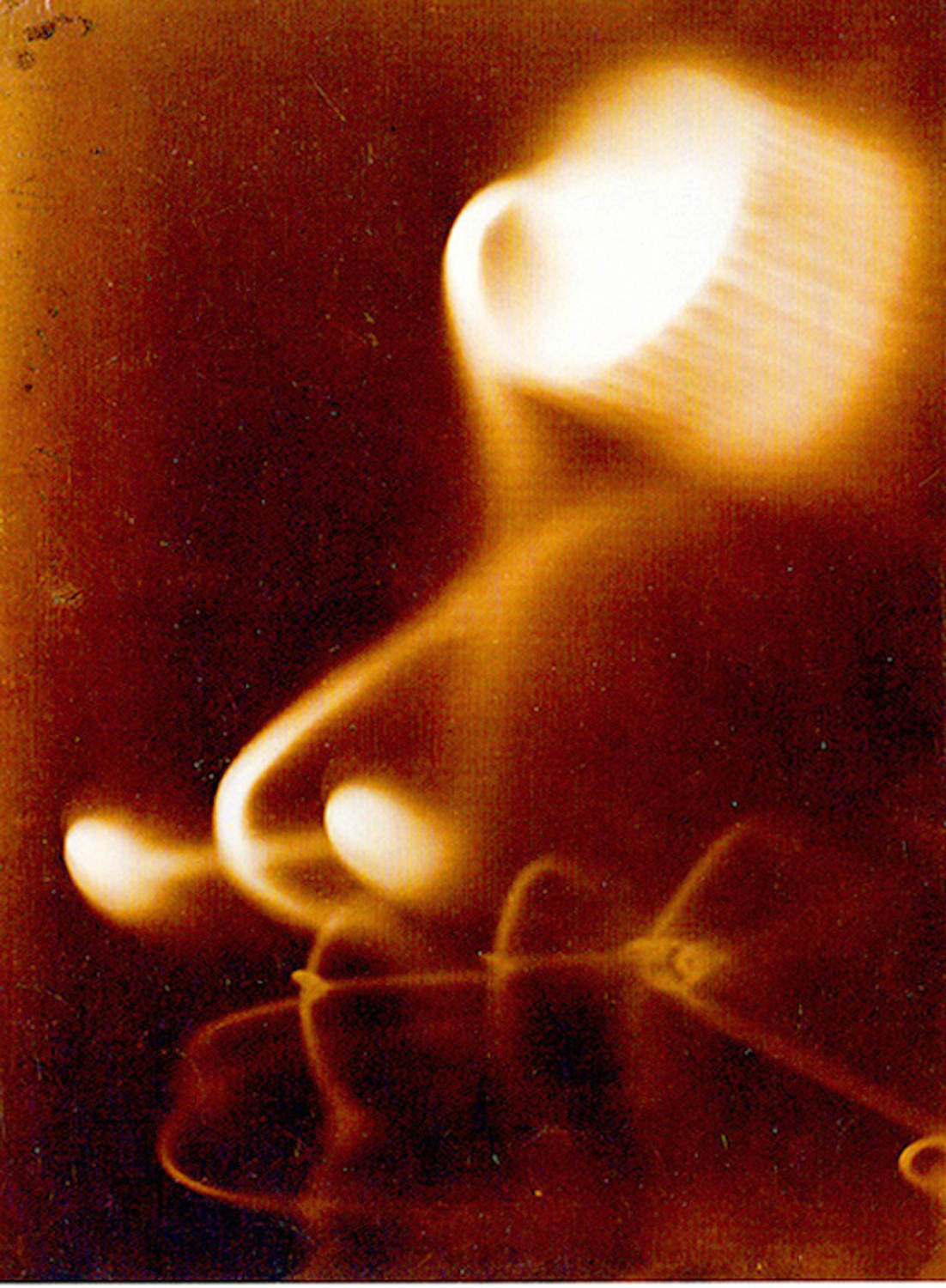
Steinert's experimental techniques were systematic and rigorous. His luminograms — images made without a camera by moving a point of light directly across photographic paper in a darkroom — explored the fundamental properties of light and time that underlie all photography. His solarised portraits, created by briefly re-exposing the negative to light during development, produced images in which the human face appears to dissolve at its edges, becoming simultaneously more graphic and more mysterious. His negative prints, in which the tonal values of the original image are reversed, transformed familiar landscapes into alien, almost hallucinatory visions.
In 1959, Steinert was appointed professor of photography at the Folkwangschule in Essen (later the Folkwang Universität der Künste), where he would teach for the remaining nineteen years of his life. At Essen, he built what was at the time the most important photography programme in Germany, training a generation of photographers who would carry his ideas into the 1960s, 1970s, and beyond. His students included many who would become significant figures in their own right, and his insistence on the artistic autonomy of photography influenced the institutional recognition of the medium across Europe.
Steinert was also a dedicated collector, and during his years at Essen he assembled a collection of historical and contemporary photographs that would eventually form the nucleus of the Folkwang Museum's photography holdings — one of the most important photography collections in Germany. His scholarly engagement with the history of the medium complemented his creative practice, and his writing on photography combined historical knowledge with aesthetic conviction in a way that was rare among practitioners.
Otto Steinert died in Essen in 1978, at the age of sixty-three. His legacy is that of an artist, educator, and organiser who almost single-handedly revived German photography from the devastation of the war and the stagnation of the post-war years. Subjektive Fotografie, while it eventually gave way to other movements and approaches, established the principle that photography is an art of personal vision — that what matters is not what the camera sees but what the photographer sees through the camera. This principle, which seems obvious today, was radical in the context of 1950s Europe, and its establishment owed more to Steinert than to any other single figure.