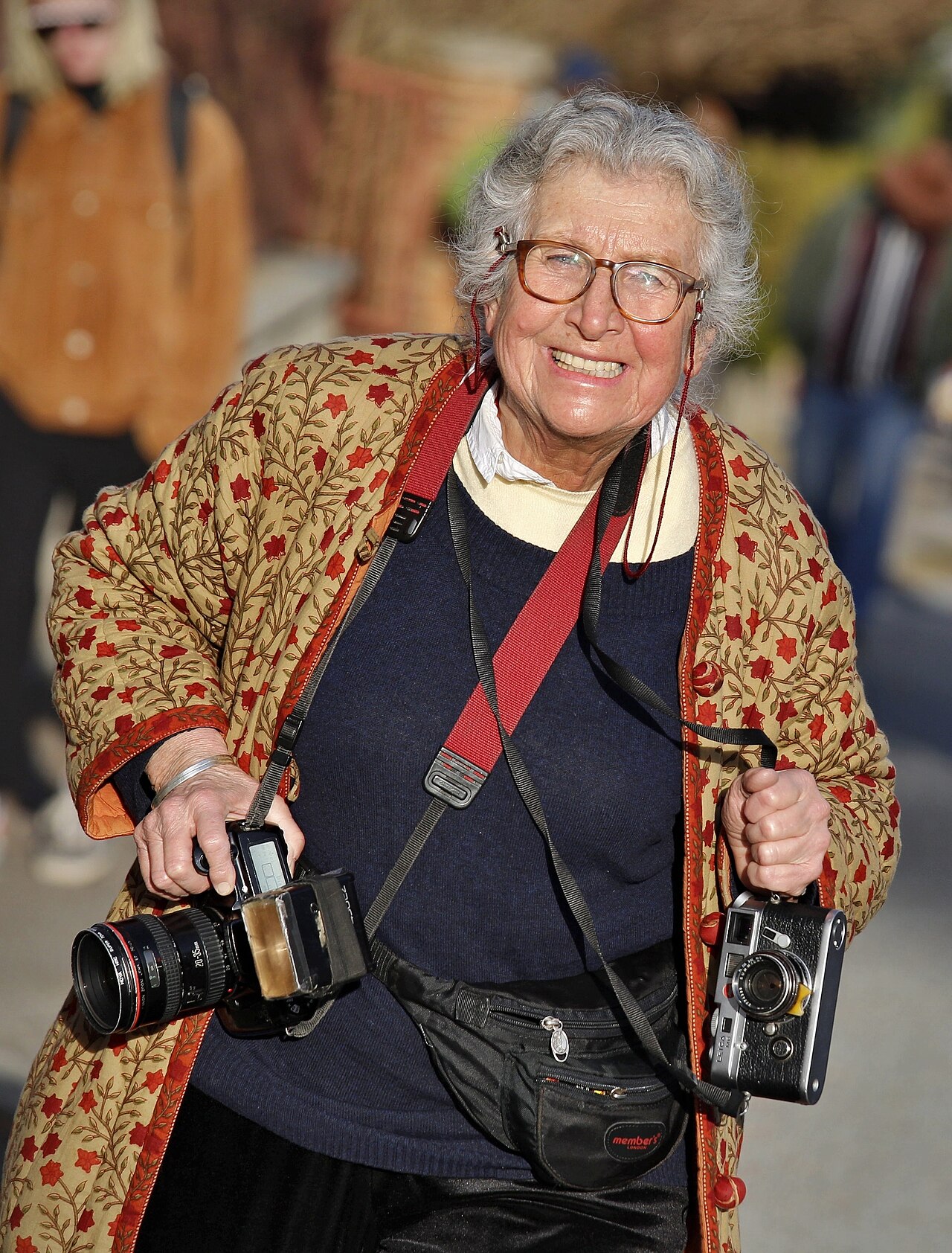
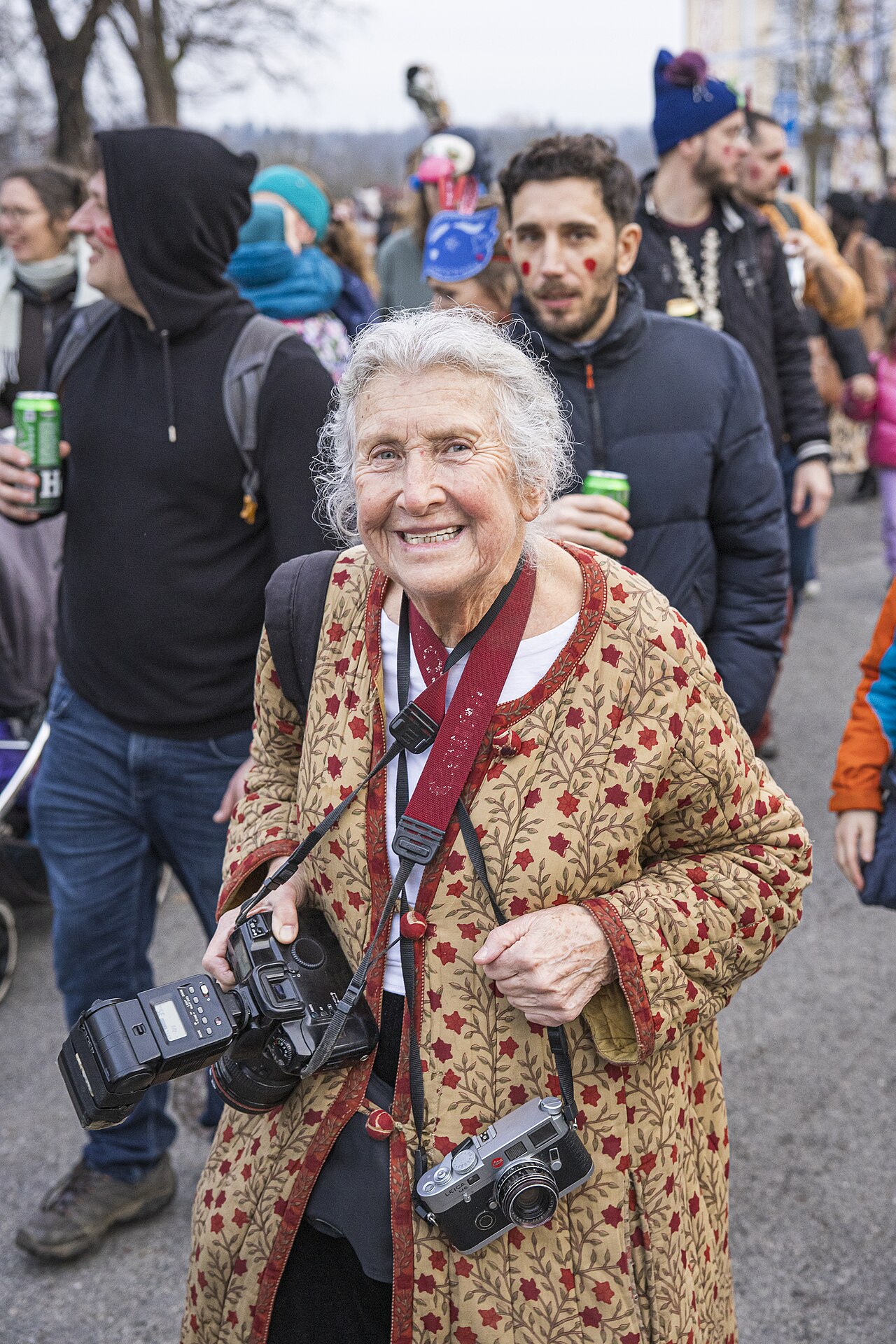
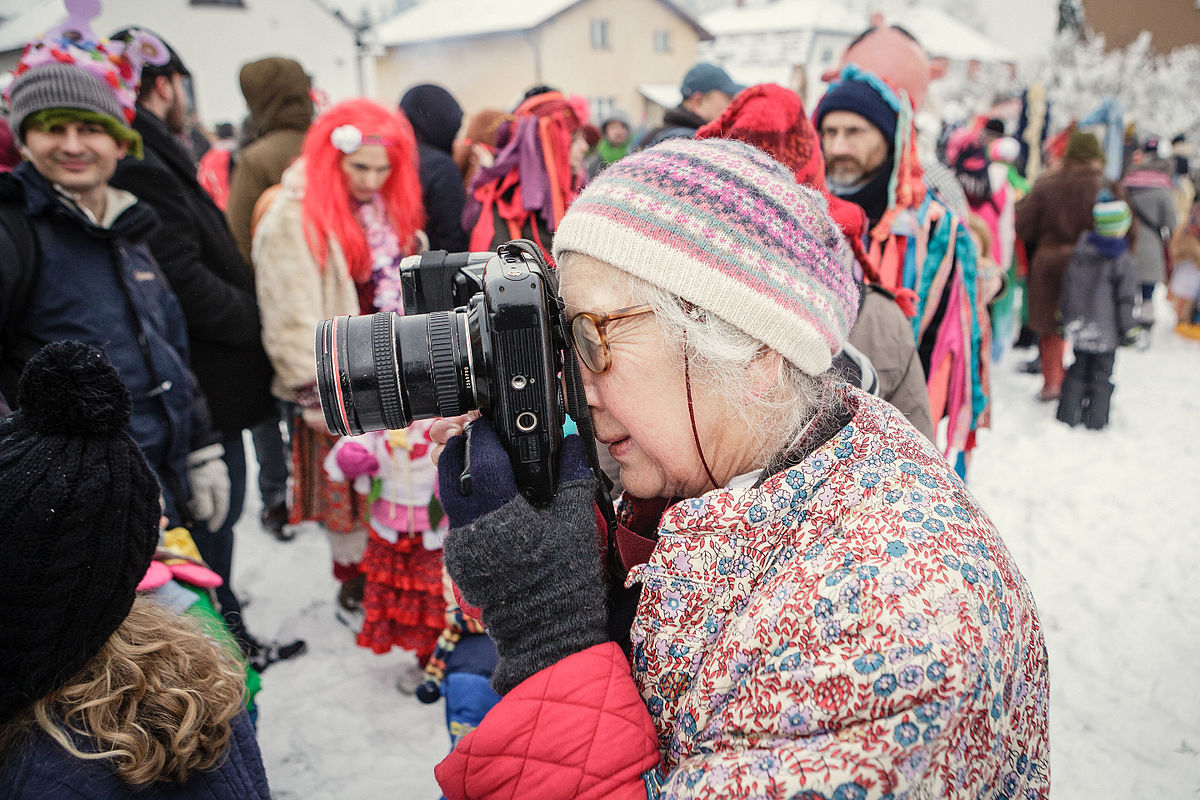
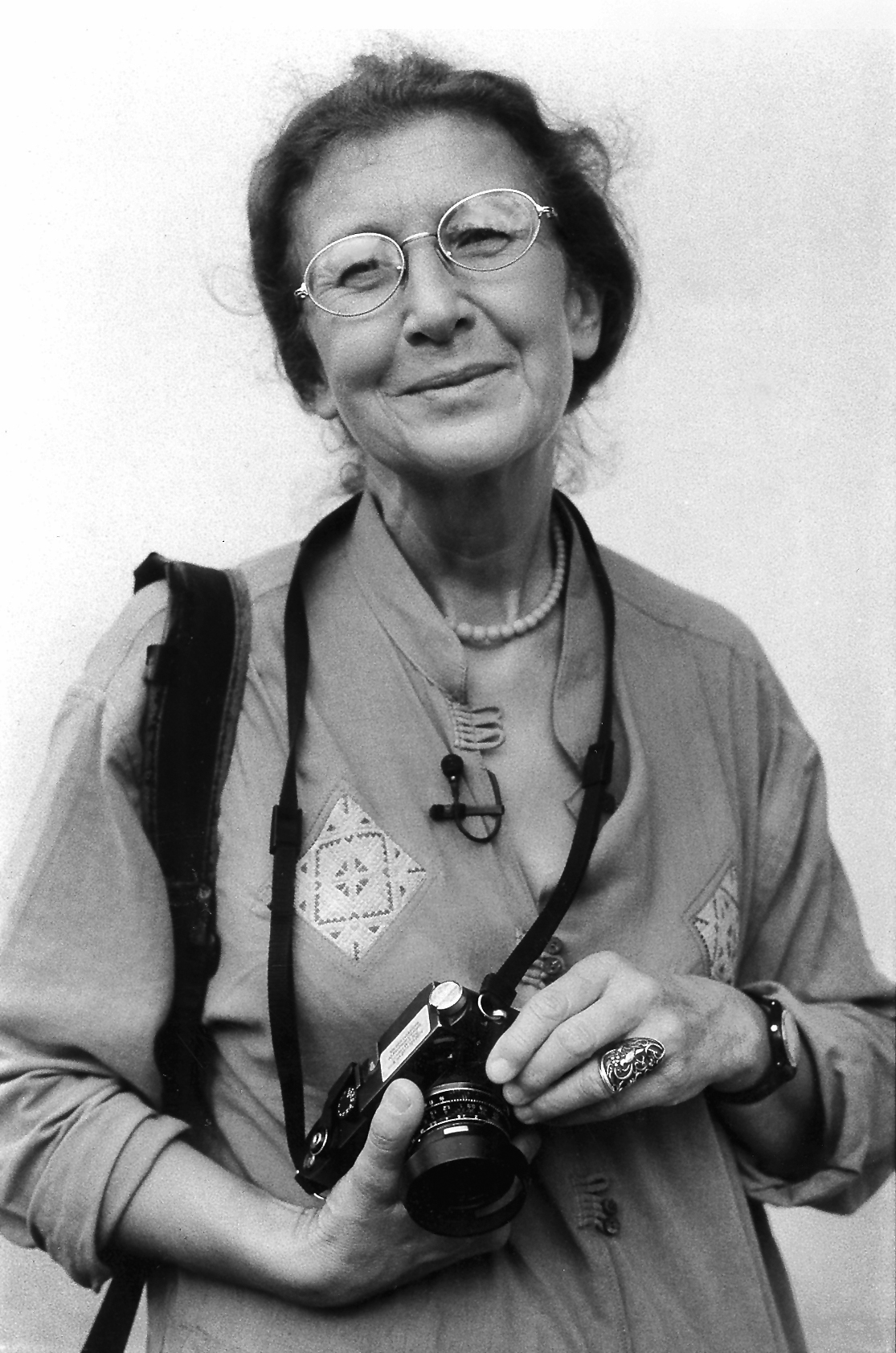
Markéta Luskačová was born in Prague in 1944, during the final year of the German occupation of Czechoslovakia. She grew up in the post-war period, studied sociology and philosophy at Charles University in Prague, and it was through her sociological research that she first encountered the communities that would become the subject of her most celebrated photographic work. In the mid-1960s, while conducting fieldwork among rural communities in Slovakia, she discovered the religious pilgrimages that had survived decades of official atheism under communist rule. These encounters transformed her from a social scientist into a photographer.
The Pilgrims series, begun in 1967 and continued over the following years, documents the Catholic pilgrimage sites of rural Slovakia, where elderly villagers, many of them women, gathered in acts of communal devotion that seemed to belong to another century. Luskačová's photographs of these pilgrimages are remarkable for their combination of formal beauty and emotional depth. Faces weathered by decades of hardship are lit with an intensity that recalls the chiaroscuro of Rembrandt; hands clasped in prayer are rendered with a sculptural precision that gives them monumental weight. Yet there is nothing heavy or portentous about these images. They are suffused with a warmth and a gentleness that speak of the photographer's genuine respect for her subjects.
The Soviet invasion of Czechoslovakia in August 1968 interrupted Luskačová's work and fundamentally altered the course of her life. Although she did not leave Czechoslovakia immediately, the political repression that followed the Prague Spring made it increasingly difficult for her to work freely. In 1975, she emigrated to England, settling in London, where she would remain for the rest of her career. The transition was painful — she was leaving behind not only her homeland but the communities she had photographed with such devotion — but it also opened new avenues for her work.
In London, Luskačová found a new subject in the Spitalfields market, the great wholesale fruit and vegetable market in the East End that was then still a thriving centre of working-class commerce. She began photographing the market's traders, porters, and customers in the late 1970s, producing a body of work that captured the noise, energy, and camaraderie of a vanishing way of life. Her Spitalfields photographs share the same qualities that distinguish the Pilgrims series: an intimate, close-range style, a sensitivity to gesture and expression, and a profound respect for the dignity of manual labour.
Luskačová also photographed extensively in other parts of London, particularly the neighbourhoods of the East End with their immigrant communities and street markets. Her work from this period documents a London that was rapidly changing — the old working-class communities giving way to gentrification, the markets being redeveloped, the social fabric being rewoven — and her photographs now serve as an invaluable record of a city in transition.
Throughout her career, Luskačová has received recognition from both Czech and British institutions. Her work has been exhibited at the Victoria and Albert Museum, the Photographers' Gallery in London, the Museum of Decorative Arts in Prague, and numerous other venues. She has published several books, including collections of her pilgrim photographs and her London market work. In 2019, a major retrospective was held at Martin Parr Foundation in Bristol, bringing renewed attention to a body of work that spans more than five decades.
What makes Luskačová's photography exceptional is not its formal innovation but its moral quality. She belongs to a tradition of humanist photography that includes August Sander, Roman Vishniac, and Josef Koudelka — photographers for whom the act of looking is inseparable from the act of caring. Her photographs do not sentimentalise their subjects, nor do they aestheticise poverty or suffering. They simply look, with patience and with love, at people going about the ordinary business of their lives, and in doing so they reveal something of the quiet heroism that such ordinariness contains.
Now in her eighties, Luskačová continues to live in London, surrounded by an archive of photographs that together constitute one of the most sustained and deeply felt records of community life in the second half of the twentieth century. Her influence is felt not so much in stylistic imitation as in the example she provides of what photography can be when it is practised with patience, humility, and an unwavering commitment to the people it serves.