Josef Koudelka was born in 1938 in the small Moravian town of Boskovice, in what was then Czechoslovakia. He studied at the Czech Technical University in Prague and trained as an aeronautical engineer, a profession he practised for several years while devoting every spare hour to photography. From the early 1960s he began photographing theatrical productions for the Prague theatre Divadlo Za Branou (Theatre Behind the Gate), developing a dramatic, high-contrast visual language that owed as much to the stage's interplay of light and darkness as to any photographic tradition. His theatre work sharpened his instinct for the charged moment, for the gesture that contains the whole weight of a narrative.
Alongside his theatre photography, Koudelka embarked on what would become one of the defining projects of his career: an extended documentation of Romani communities across Czechoslovakia, Romania, Spain, France, and other parts of Europe. Working in stark black and white, he immersed himself in Romani life — the celebrations, the music, the funerals, the cramped interiors, the faces marked by hardship and fierce vitality. His images were neither sentimental nor sociological. They possessed a raw, almost mythic intensity, as though he were photographing not a marginalised people but an epic, timeless civilisation glimpsed at the edge of extinction.
In August 1968, the trajectory of Koudelka's life and work was transformed overnight. When Soviet tanks rolled into Prague to crush the reform movement known as the Prague Spring, Koudelka was in the city with his camera. Over the course of the invasion's first chaotic days, he produced one of the most extraordinary bodies of photographic witness ever made. He photographed citizens confronting tanks with bare hands, streets filled with smoke and debris, the bewildered and defiant faces of ordinary Praguers whose world was collapsing around them. One image — a bare wrist holding a watch against a backdrop of deserted Wenceslas Square — became an icon of resistance, recording the precise moment at which a nation's freedom was extinguished.
The Prague photographs were smuggled out of Czechoslovakia and published internationally under the mysterious credit "P.P." (Prague Photographer), to protect Koudelka and his family from reprisal. They appeared in newspapers and magazines across the world and won the Robert Capa Gold Medal from the Overseas Press Club — awarded anonymously, the only time in the prize's history. Koudelka's authorship was not publicly revealed until 1984. The images remain among the most visceral and politically significant photographs of the twentieth century, a record of state violence met by individual courage that transcends its historical moment.
In 1970, Koudelka left Czechoslovakia, ostensibly to travel to the West on a temporary exit visa. He never returned. He became a stateless person — a condition he would maintain for sixteen years, carrying no passport from any country and declaring his nationality as "uncertain." He wandered across Western Europe, sleeping in parks, on floors, in the houses of friends, carrying little more than his cameras and a sleeping bag. This nomadic existence was not merely circumstantial but philosophical: Koudelka believed that the condition of exile, of permanent displacement, was essential to the intensity with which he saw. In 1971, he was invited to join Magnum Photos, the legendary cooperative founded by Henri Cartier-Bresson, Robert Capa, and others, and he has remained a member ever since.
In 1975, Robert Delpire published Gypsies, Koudelka's monumental book of Romani photographs. It was immediately recognised as a masterpiece — not a documentary study but a deeply personal, almost operatic vision of a people and their world. The images were sequenced with extraordinary care, building from intimate portraits to sweeping landscapes, from celebrations to mourning, creating a visual narrative of astonishing emotional range. Gypsies established Koudelka as one of the most powerful photographic voices of his generation, an artist whose work combined the documentary rigour of the Magnum tradition with a romantic, almost expressionist intensity that was entirely his own.
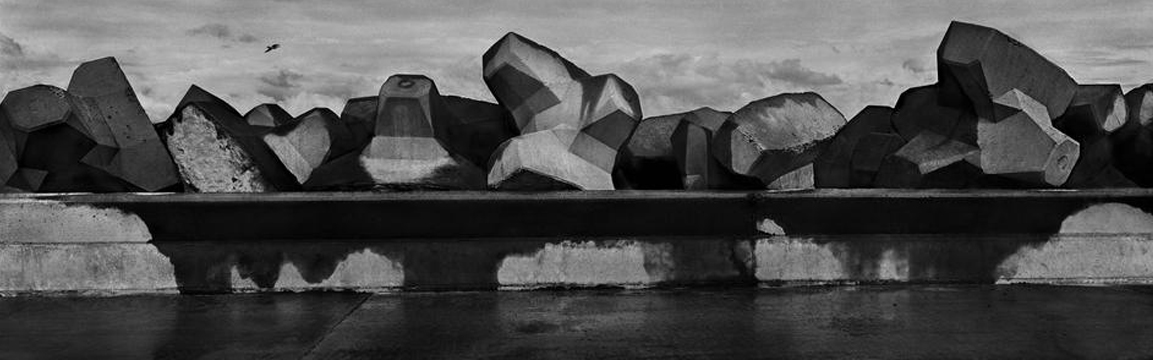
From the late 1980s onward, Koudelka embarked on a radical new direction, adopting a panoramic camera to photograph landscapes of devastation and transformation across the Mediterranean, the Middle East, and the industrial zones of Western Europe. The resulting body of work, published as Chaos in 1999, presented vast, sweeping vistas of quarries, ruins, demolished buildings, and scarred terrain — landscapes from which human presence had been erased or reduced to insignificance. The panoramic format, with its extreme horizontal compression, lent the images an almost cinematic grandeur, as though Koudelka were surveying the aftermath of some catastrophe too large for a single frame to contain.
In 1986, Koudelka accepted French citizenship, ending sixteen years of statelessness. But exile remained central to his identity and his art. In 2008 and the years following, he turned his panoramic camera to the Israeli separation wall in the West Bank, producing a body of work — published as Wall in 2013 — that brought his lifelong preoccupation with borders, barriers, and the landscapes of division into searing contemporary focus. A major retrospective, Nationality: Uncertain, toured internationally in 2013, confirming Koudelka's status as one of the most uncompromising and visually powerful photographers alive. He continues to work and to travel, a nomad still, driven by the conviction that photography demands nothing less than total commitment and total freedom.