John Gossage was born in 1946 in New York City but has spent most of his working life in Washington, D.C., a city whose margins, neglected spaces, and transitional zones have provided the primary subject matter for one of the most distinctive bodies of work in contemporary photography. He came to the medium young, studying with Lisette Model and Alexey Brodovitch as a teenager in New York, and by his early twenties he was already exhibiting and publishing work that demonstrated an unusual sensitivity to the textures and rhythms of urban landscapes that most photographers overlooked entirely.
Gossage's formative experiences as a photographer were shaped by walking. He is, in the most fundamental sense, a photographer who walks — not through the grand avenues and monumental spaces for which Washington is known, but through its back lots, overgrown parks, abandoned edges, and the nameless spaces between one destination and another. His photographs attend to the ground-level details of these places: the tangle of weeds pushing through asphalt, the rusted chain-link fence half-buried in undergrowth, the discarded objects that accumulate in forgotten corners. There is nothing picturesque about these subjects, yet in Gossage's hands they acquire a density of attention that transforms them into something approaching the sublime.
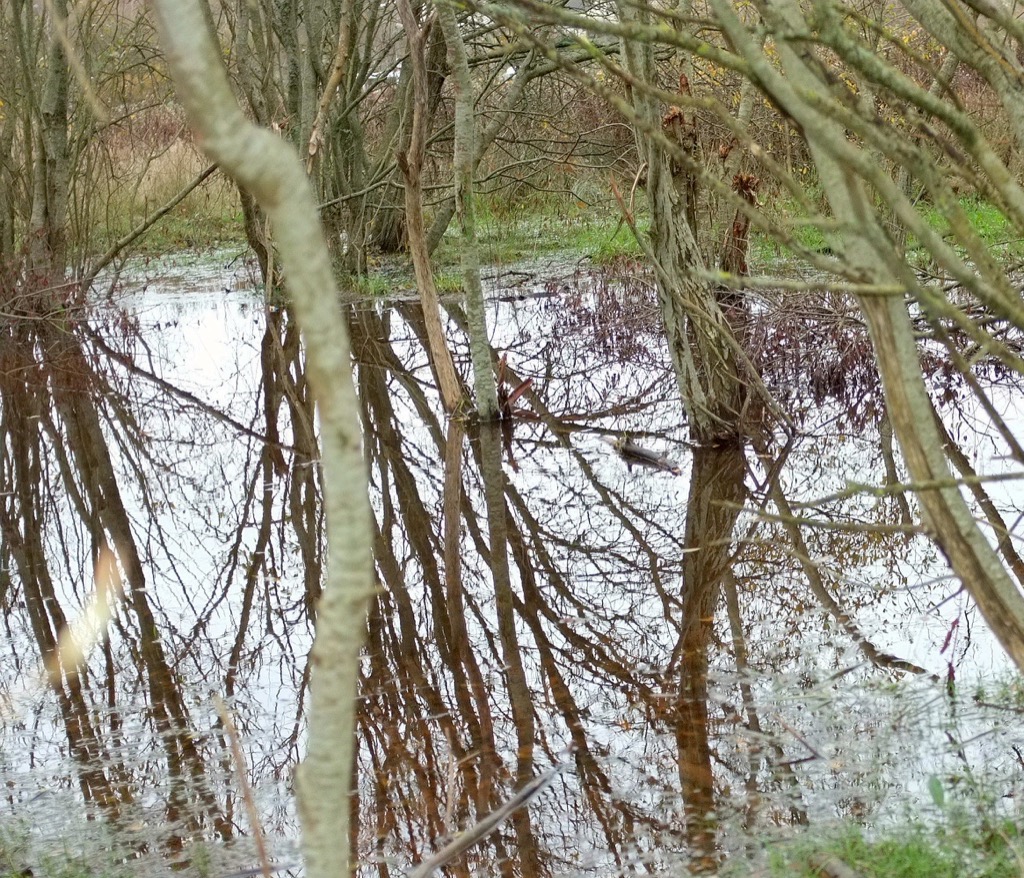
The work for which Gossage is best known is The Pond, published in 1985 by Aperture. The book documents a small, unremarkable body of water in northwest Washington, D.C. — a pond surrounded by scrubby woodland, accessible by a few dirt paths, visited by dog walkers and occasional fishermen. In Gossage's sequencing, the journey to and around this minor landscape feature becomes an extended meditation on seeing, on the relationship between the photographer and the terrain he traverses, and on the capacity of the photobook to construct an experience that unfolds in time, page by page, image by image. The Pond is now widely regarded as one of the great photobooks of the twentieth century, a work whose influence on subsequent generations of photobook makers has been immense.
What makes The Pond remarkable is not the individual photographs, many of which are deliberately plain, but the relationships between them. Gossage understood, perhaps more deeply than any photographer of his generation, that the photobook is not a portfolio — not a collection of individual images bound together for convenience — but a form in its own right, with its own syntax, its own rhythms, and its own capacity for meaning. The sequence of images in The Pond creates a narrative without story, a sense of movement through space and time that is closer to music than to conventional photography. Each image anticipates the next, and the cumulative effect is something that no single photograph could achieve.
Following The Pond, Gossage continued to produce photobooks with a commitment to the form that has few parallels in the medium. Stadt des Schwarz (1987) documented Berlin before and after the fall of the Wall, bringing the same close-range attentiveness to the textures of a divided city. The Romance Industry (2002) explored the landscapes of desire and consumption. Berlin in the Time of the Wall (2004) returned to the German capital with a more explicit historical focus. Each book was conceived as a complete work, with every aspect of design, sequencing, paper choice, and printing contributing to the overall experience.
Gossage's approach to photography is deceptively simple. He works with relatively modest equipment, prints his own work, and maintains a practice grounded in the daily habit of walking and looking. Yet the apparent simplicity conceals a sophisticated understanding of photographic history and theory. He is deeply read in literature and philosophy, and his photographs engage with questions about perception, memory, and the nature of place that connect to broader intellectual traditions. His close friendship with William Christenberry and his admiration for Walker Evans situate him within an American tradition of vernacular attention, while his engagement with European photobook culture links him to a parallel lineage running through Ed Ruscha, Bernd and Hilla Becher, and the Dutch and German photobook traditions.
Now in his late seventies, Gossage continues to photograph, to make books, and to exert an influence on the photobook world that is difficult to overstate. His contribution to the medium lies not in any single image but in the demonstration that the photobook can be a vehicle for sustained, immersive attention to the world — that a walk through an unremarkable landscape, when sequenced and presented with care, can become a profound aesthetic experience. In an era of image overload, Gossage's work stands as a reminder that photography's deepest rewards come not from the spectacular but from the patient, repeated act of looking at what is already there.