Jeff Mermelstein was born in 1957 in New Brunswick, New Jersey, and has spent the better part of four decades walking the streets of New York City with a camera, producing a body of work that ranks among the sharpest and most witty contributions to the American street photography tradition. He studied at the School of Visual Arts in New York and began photographing professionally in the 1980s, working as a freelance photojournalist while developing the personal street work that would ultimately define his reputation. His earliest influences included the great New York street photographers — Garry Winogrand, Lee Friedlander, Helen Levitt — but from the beginning Mermelstein's eye was distinctly his own: sharper, funnier, more attuned to the absurd theatre of urban life.
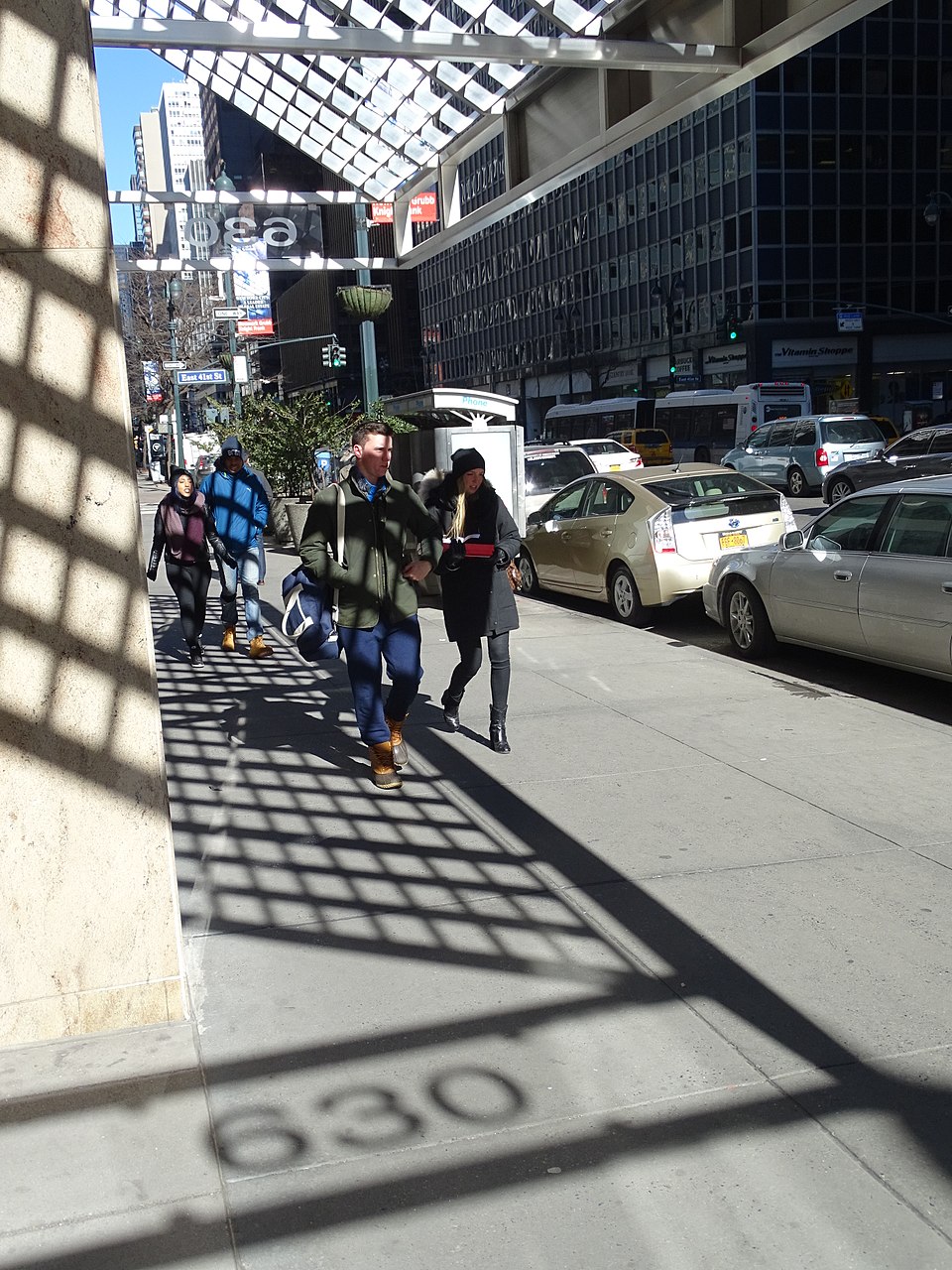
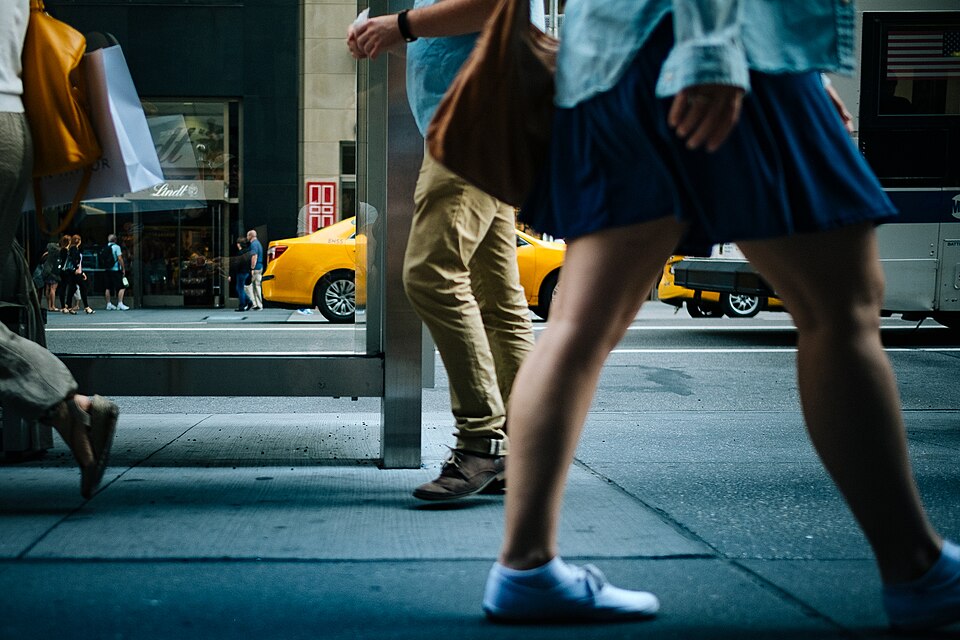
Mermelstein's signature lies in his ability to isolate moments of visual coincidence and human comedy from the relentless flow of the New York sidewalk. His photographs are populated by businessmen and tourists, delivery workers and fashion models, the wealthy and the destitute, all caught in instants of unconscious performance. A woman's extravagant hat collides visually with a passing truck; a suited executive's face contorts in mid-sneeze; a pile of discarded clothing assumes the posture of a sleeping body. These are not decisive moments in the Cartier-Bresson sense of compositional perfection but rather decisive absurdities — instants when the chaos of the street momentarily coheres into something hilarious, poignant, or unsettling.
His first major book, Sidewalk (1999), established him as a leading figure in contemporary street photography. The book presented a decade of New York street work in a sequence that communicated the density, velocity, and human variety of the city with an energy that matched its subject. Reviewers noted the book's rare combination of formal intelligence and emotional immediacy — Mermelstein's photographs were precisely composed and exquisitely timed, yet they never felt calculated or detached. They communicated a genuine engagement with the spectacle of urban life, a delight in its unpredictability that was infectious.
The events of September 11, 2001, placed Mermelstein at the centre of one of the most photographed catastrophes in history. Living and working in Lower Manhattan, he was among the first photographers on the scene, and his images of the World Trade Center aftermath — the dust-covered survivors, the bewildered faces, the eerie landscapes of destruction — were published widely and received the W. Eugene Smith Grant for Humanistic Photography. These photographs represented a departure from his usual register, demonstrating that the same quick eye and instinctive framing that served him on the sidewalk could also respond to moments of genuine historical gravity.
In the years following September 11, Mermelstein continued to walk and photograph New York, but his work began to evolve. He remained committed to the street but became increasingly interested in the details and textures of urban life rather than solely in the human figures that had dominated his earlier work. He photographed discarded objects, fragments of signage, the detritus of consumer culture, and the strange visual collisions produced by the layering of advertisements, graffiti, and architectural surfaces that characterise the contemporary city.
His most provocative recent project has been Arena, published in 2018 by Jaap Scheeren, and a related Instagram-based project. In this work, Mermelstein photographed the screens of strangers' mobile phones on the subway and in the street, capturing intimate text messages, social media feeds, and personal communications in close-up. The project raised pointed questions about privacy, public space, and the way digital technology has transformed the nature of public life — the same sidewalks Mermelstein had been photographing for decades were now populated by people whose attention was directed at screens rather than at each other.
Mermelstein has taught photography at numerous institutions and has been awarded the European Publishers Award for Photography, the W. Eugene Smith Grant, and the New York Foundation for the Arts Fellowship, among other recognitions. His work is held in the collections of the Museum of Modern Art, the Whitney Museum of American Art, the San Francisco Museum of Modern Art, and numerous other institutions. He remains one of the most active and vital practitioners of street photography in America, a walker whose daily rounds continue to yield images of startling wit and formal precision.