Jacques Henri Lartigue was born on 13 June 1894 in Courbevoie, a suburb of Paris, into a wealthy and indulgent family that provided him with both the leisure and the equipment to begin photographing at an astonishingly early age. His father, Henri Lartigue, was a prosperous businessman and an enthusiastic amateur photographer who gave Jacques his first camera when the boy was six years old. By the age of eight, Lartigue was making photographs of remarkable sophistication — images of family members jumping off staircases, flying homemade gliders, tumbling into swimming pools, and hurtling down hillsides in improvised go-carts — that captured the kineticism and sheer physical joy of childhood with a freshness that remains startling more than a century later.
What made Lartigue's early photographs extraordinary was not simply their technical accomplishment but their emotional quality. The young Lartigue was obsessed with capturing movement and with freezing the fleeting instants of happiness that surrounded him — the splash of water, the arc of a jump, the speed of a racing car. He described his camera as a device for catching life in the act of passing, and from the beginning his photographs were animated by an exuberance and a delight in the visible world that set them apart from virtually everything else being made at the time. While the Pictorialists were labouring over soft-focus allegories and the documentarians were cataloguing social conditions, Lartigue was simply recording the pleasure of being alive.
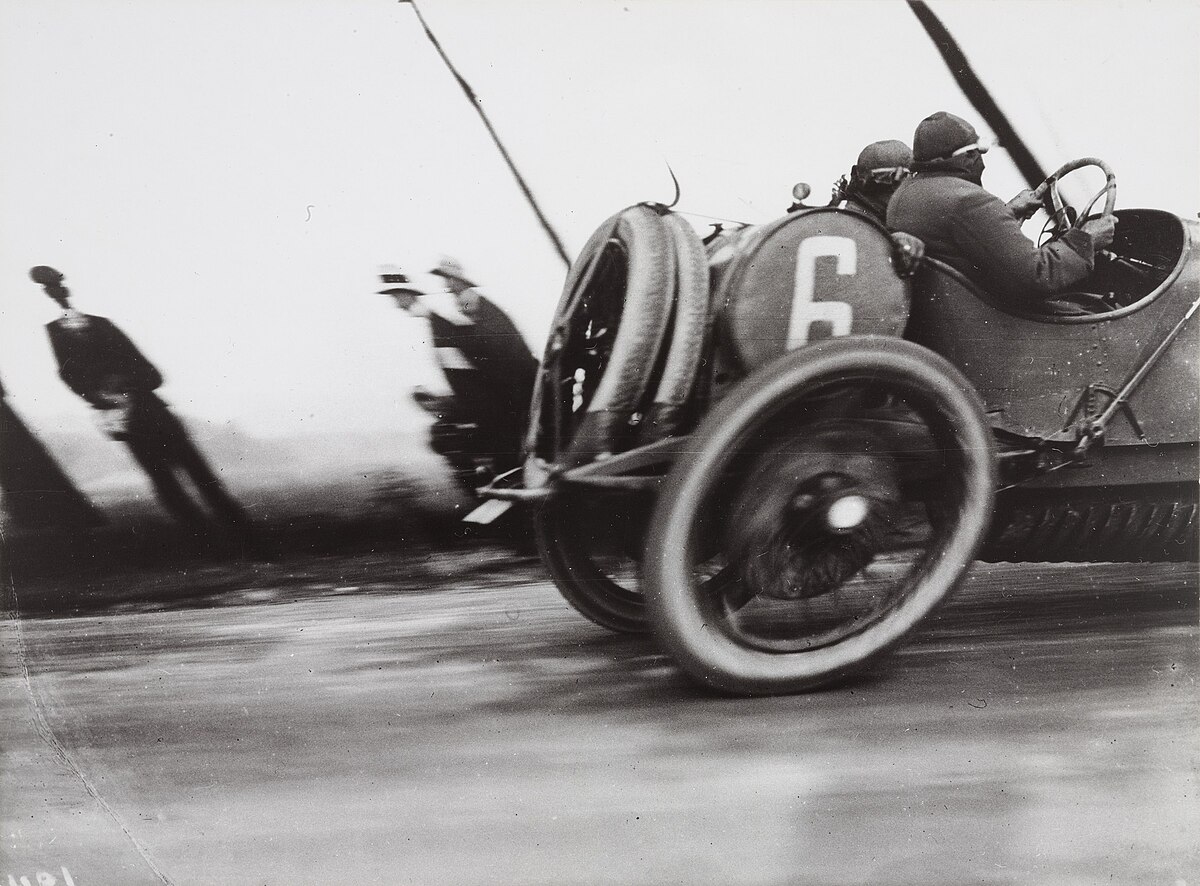
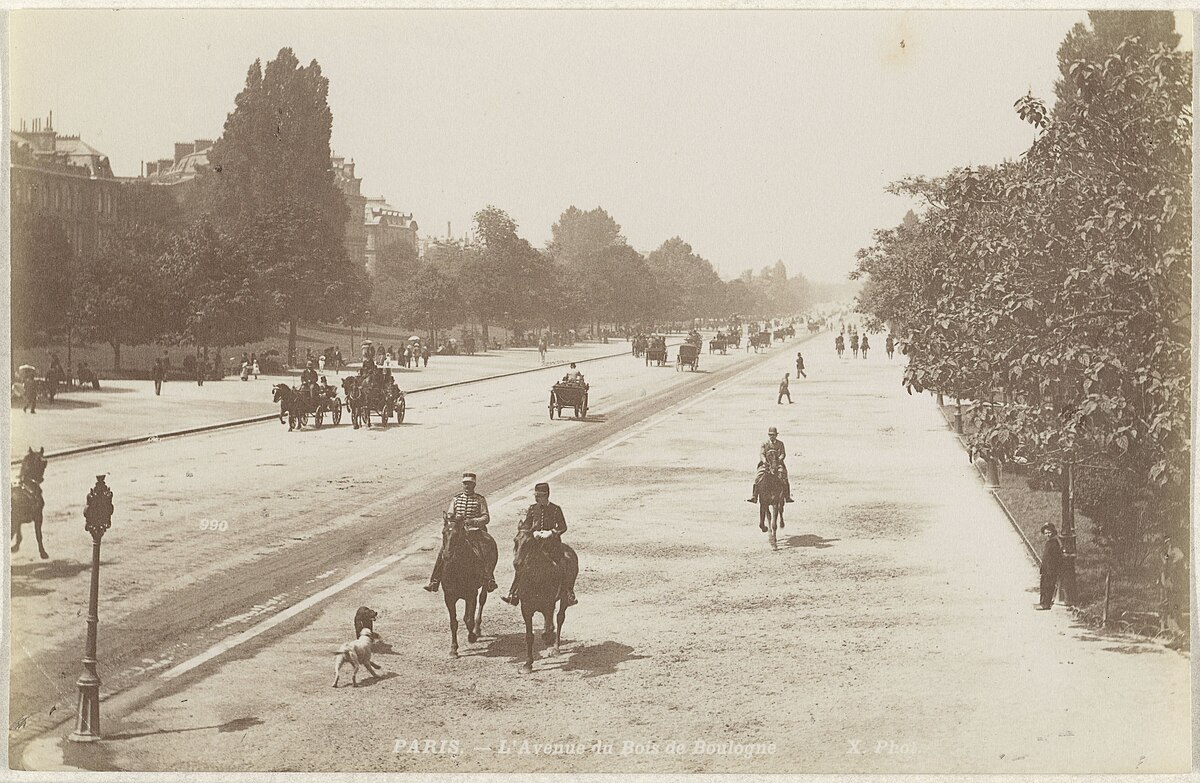
Lartigue's family world was one of Belle Époque affluence — elegant women promenading in the Bois de Boulogne, automobile races, aviation meets, beach holidays on the Atlantic coast — and he photographed all of it with the same spontaneous enthusiasm. His images of the early automobile age, particularly the famous distorted racing car from the 1912 Grand Prix de l'A.C.F., became icons of speed and modernity. His photographs of his brother Zissou and cousin Bichonnade leaping, flying, and falling captured a private world of inventive play that resonated with a universal experience of childhood freedom.
Despite the quality of his photographs, Lartigue did not consider himself primarily a photographer. Throughout his adult life, he regarded himself as a painter, and it was painting that occupied his professional ambitions. He exhibited his canvases at Parisian salons and galleries, pursued commissions, and maintained a studio practice alongside his ceaseless photographic activity. The photographs were personal, kept in albums alongside diary entries and drawings, a private visual record of a life lived with extraordinary fullness rather than a body of work intended for public exhibition.
It was not until 1963, when Lartigue was sixty-nine years old, that the wider world discovered his photographs. John Szarkowski, the newly appointed director of photography at the Museum of Modern Art in New York, encountered Lartigue's work and recognised in it something that the art world had entirely overlooked. Szarkowski mounted an exhibition at MoMA that same year, and almost overnight Lartigue was transformed from an unknown amateur into one of the most celebrated photographers of the twentieth century. His images appeared on the cover of Life magazine, and the art world embraced his work with an enthusiasm that astonished Lartigue himself.
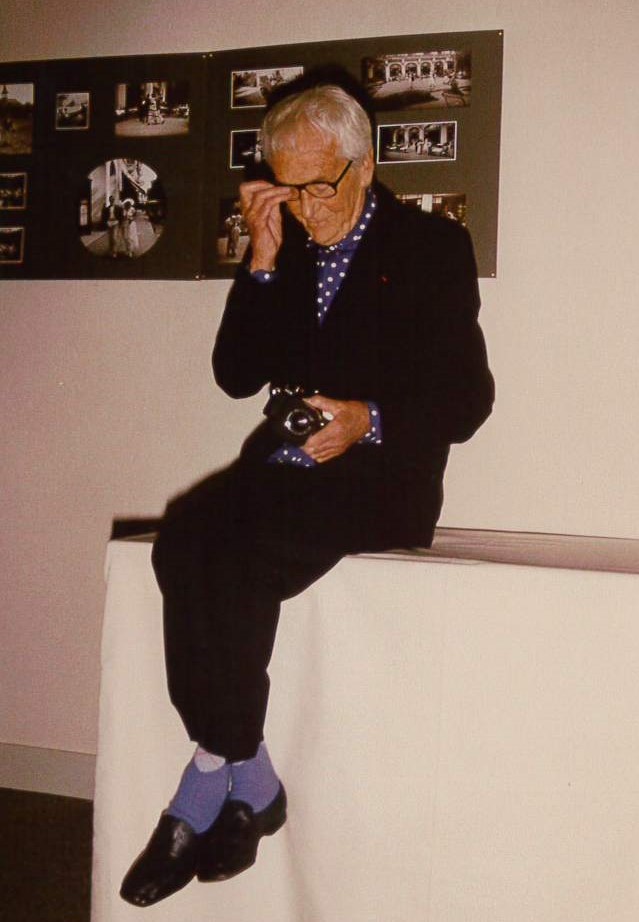
The late recognition freed Lartigue to revisit and organise the vast archive of photographs he had accumulated over six decades. He continued to photograph actively into his eighties and nineties, producing colour work of considerable charm and maintaining the diary — a combination of photographs, drawings, and handwritten text — that he had kept since childhood. In 1979, the French government appointed him official photographer of the president, and he made a celebrated portrait of Valéry Giscard d'Estaing. In his final years, he donated his entire archive — hundreds of thousands of photographs, along with the albums and diaries — to the French state, establishing the Donation Jacques Henri Lartigue, now administered from Paris.
Lartigue died in Nice on 12 September 1986, at the age of ninety-two. His legacy is unlike that of any other photographer. He was not a professional, not a theorist, not an artist in the self-conscious sense of the word. He was simply a man who had been given a camera as a child and who never lost the child's capacity for wonder. His photographs endure because they communicate something that is rare in any medium and almost unique in photography: pure, uncomplicated joy in the act of seeing.