George Platt Lynes was born in 1907 in East Orange, New Jersey, into a comfortable, cultured family. His father was a minister and his mother a woman of refined literary tastes who encouraged her son's early interest in the arts. As a teenager, Lynes was already corresponding with Gertrude Stein and had begun publishing a small literary magazine. He enrolled briefly at Yale University but left after a single term, drawn instead to the creative ferment of Paris in the late 1920s. There he immersed himself in the world of surrealism, befriending Jean Cocteau, Pavel Tchelitchew, and Glenway Wescott, the writer who would become his lifelong companion. It was in Paris that Lynes first picked up a camera, initially as an amateur, but his natural eye for composition and his instinct for dramatic lighting quickly marked him as a talent of unusual promise.
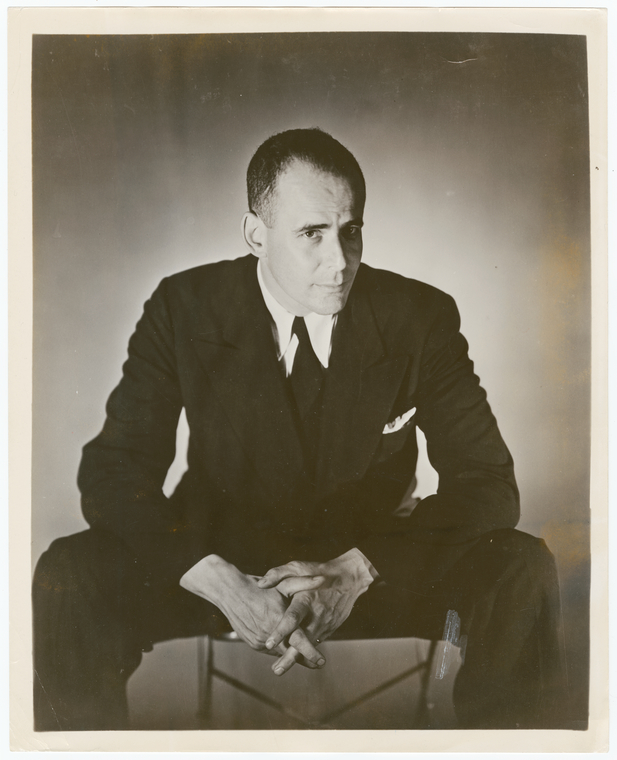
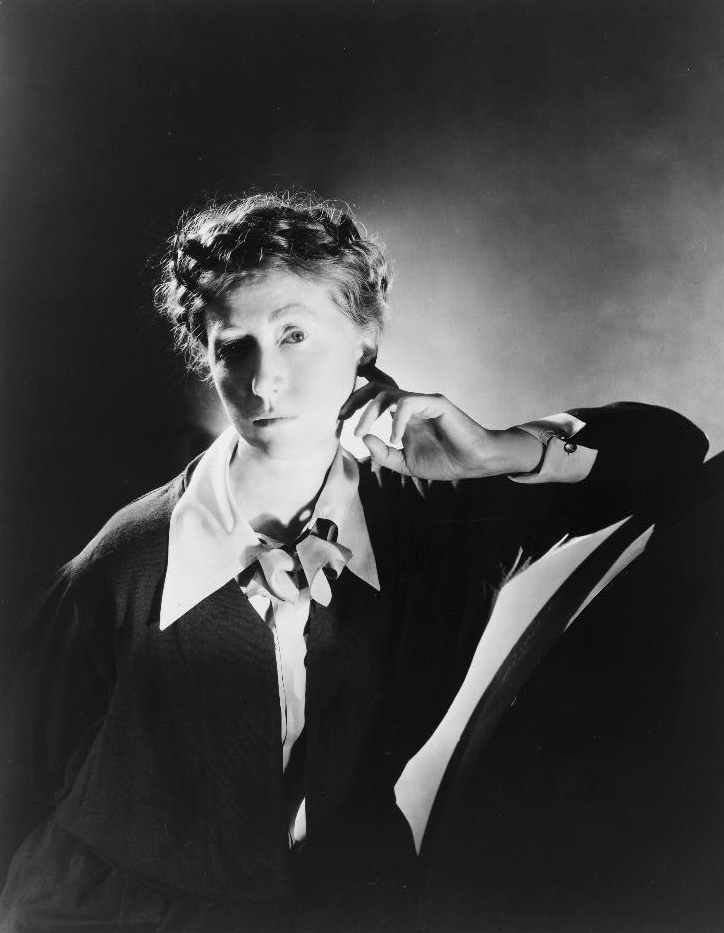
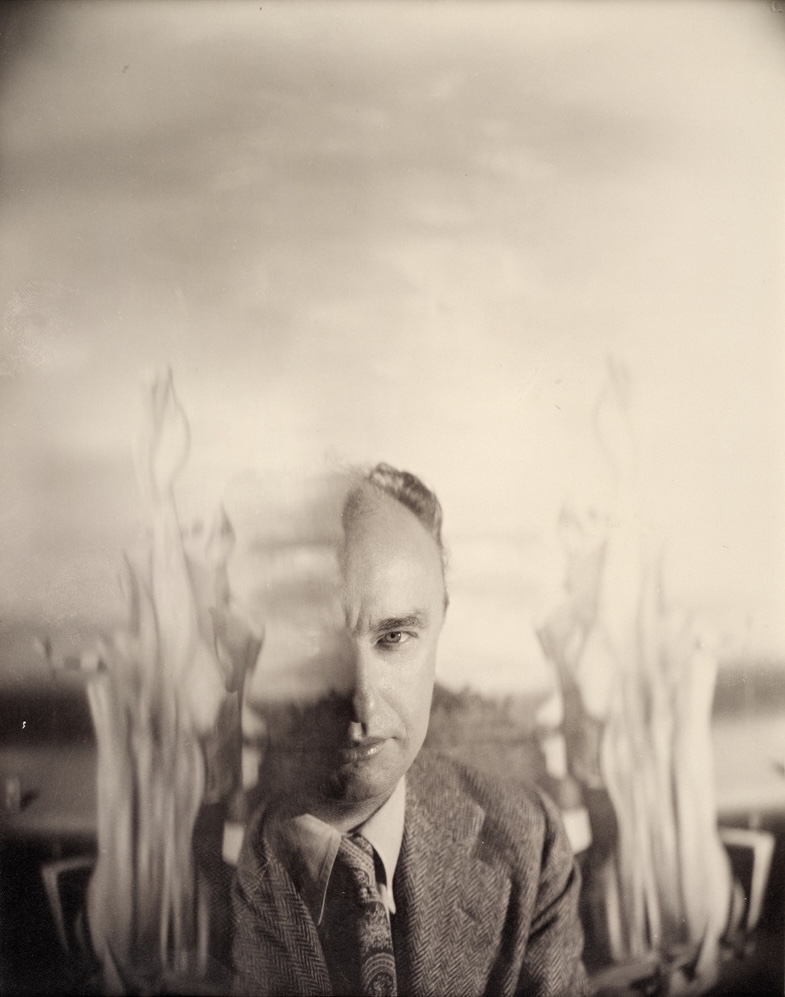
Returning to New York in the early 1930s, Lynes opened a portrait studio and rapidly established himself as one of the most sought-after photographers in American cultural life. His portraits of literary and artistic figures — Gertrude Stein, Thomas Mann, W. H. Auden, Katherine Anne Porter — combined the precision of classical studio photography with a surrealist flair for unexpected juxtaposition and theatrical lighting. His subjects appeared not merely documented but transfigured, elevated into a realm of heightened aesthetic intensity that owed as much to his admiration for the paintings of the Renaissance as to any photographic precedent.
In 1934, Lynes began working for Vogue and Harper's Bazaar, and over the next decade he became one of the defining fashion photographers of his era. His fashion work was distinguished by its sculptural quality, its dramatic use of shadow, and its willingness to treat clothing not merely as merchandise but as an element within a carefully composed visual narrative. He brought to fashion photography an intelligence and ambition that was rare in the commercial world, and his images helped establish the conventions of mid-century American fashion photography that would be carried forward by Irving Penn and Richard Avedon.
Alongside his commercial work, Lynes pursued a parallel career that he kept largely hidden from public view. Beginning in the late 1930s, he produced an extensive body of male nude photographs that were among the most accomplished and daring of their time. These images combined the classical idealism of Greek sculpture with a frank, unapologetic celebration of the male body that was extraordinary in an era when homosexuality was criminalised and the male nude was virtually absent from serious art photography. The nudes were never exhibited publicly during Lynes's lifetime; instead, they circulated among a small circle of trusted friends and collectors, and many were entrusted to Alfred Kinsey and the Institute for Sex Research at Indiana University for safekeeping.
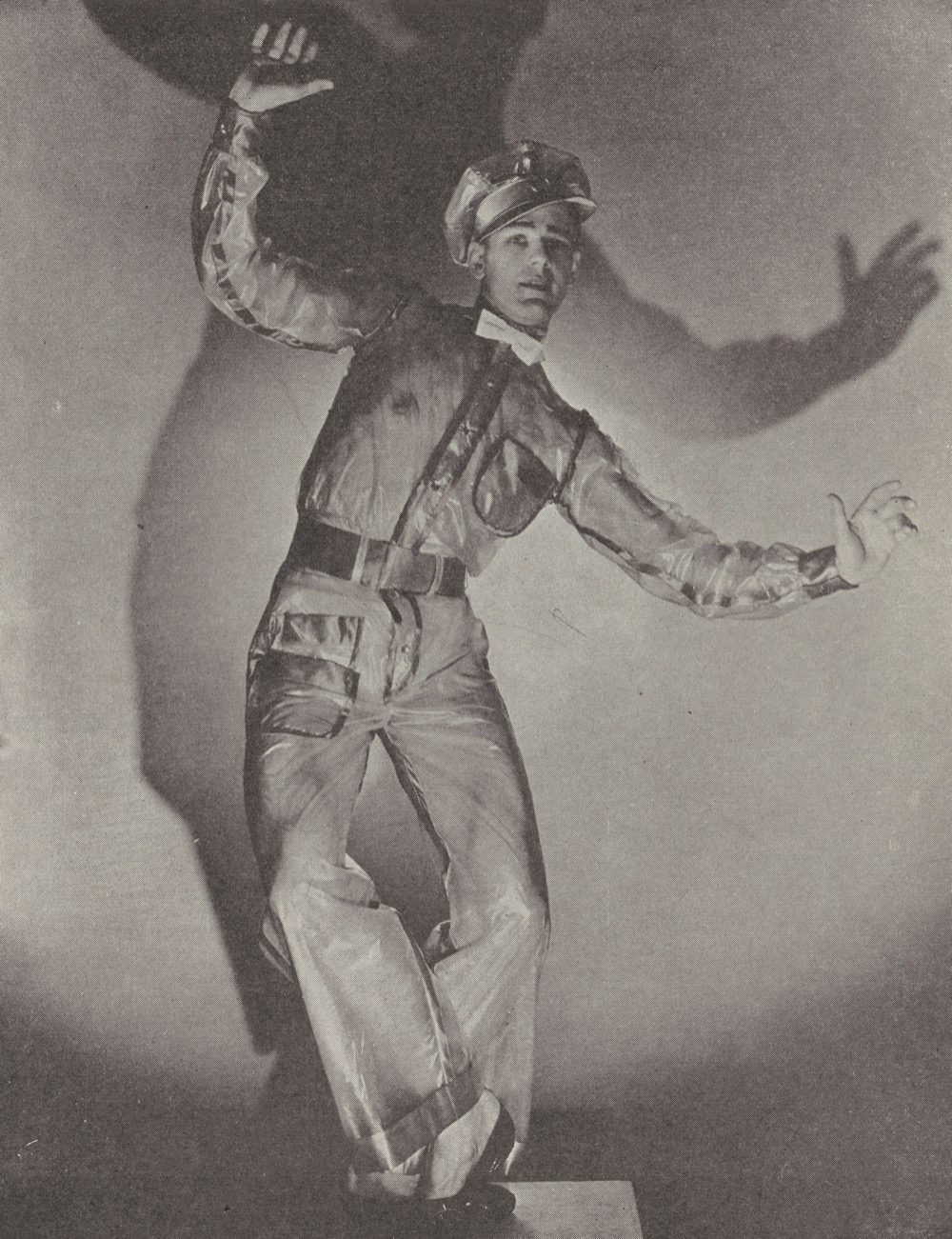
Lynes's relationship with the world of ballet was among the most fruitful of his career. In the 1940s and early 1950s, he served as the official photographer of the New York City Ballet, working closely with George Balanchine and Lincoln Kirstein to document the company's productions. His ballet photographs captured not merely the steps but the emotional and physical intensity of dance, using his mastery of studio lighting to transform the human body in motion into something that approached the condition of sculpture. These images remain among the finest dance photographs ever made, rivalled only by the later work of photographers who explicitly acknowledged Lynes's influence.
Despite his prodigious talent, Lynes's career was marked by financial instability and a growing sense of frustration. He closed his New York studio in 1948 and moved briefly to Hollywood, where he worked as a portrait photographer for Vogue's West Coast edition. The work was lucrative but unsatisfying, and he returned to New York in 1952 in declining health. He was diagnosed with lung cancer in 1954 and died the following year, at the age of forty-seven. Before his death, he destroyed many of his negatives, particularly those of his commercial work, while ensuring that his male nudes would be preserved through Kinsey's archive.
The rediscovery of Lynes's work began in the 1970s and accelerated through the 1980s and 1990s, as the history of queer art and photography began to be written in earnest. His male nudes, once hidden from view, came to be recognised as pioneering works that anticipated the frank homoeroticism of Robert Mapplethorpe by several decades. His fashion work was reassessed as among the most visually sophisticated of the mid-century period. Today, Lynes is understood as an artist of remarkable range and courage — a photographer who moved fluently between the worlds of commerce, art, and private expression, and whose finest images possess a formal beauty and emotional depth that transcend the circumstances of their making.
His legacy endures not only in the archives that house his prints but in the expanded understanding of what photography could express about desire, the body, and the complex negotiations between public persona and private identity. Lynes's work reminds us that some of the most important chapters in the history of photography were written not in galleries or magazines but in the privacy of the studio, where an artist could pursue a vision too honest for the world outside.