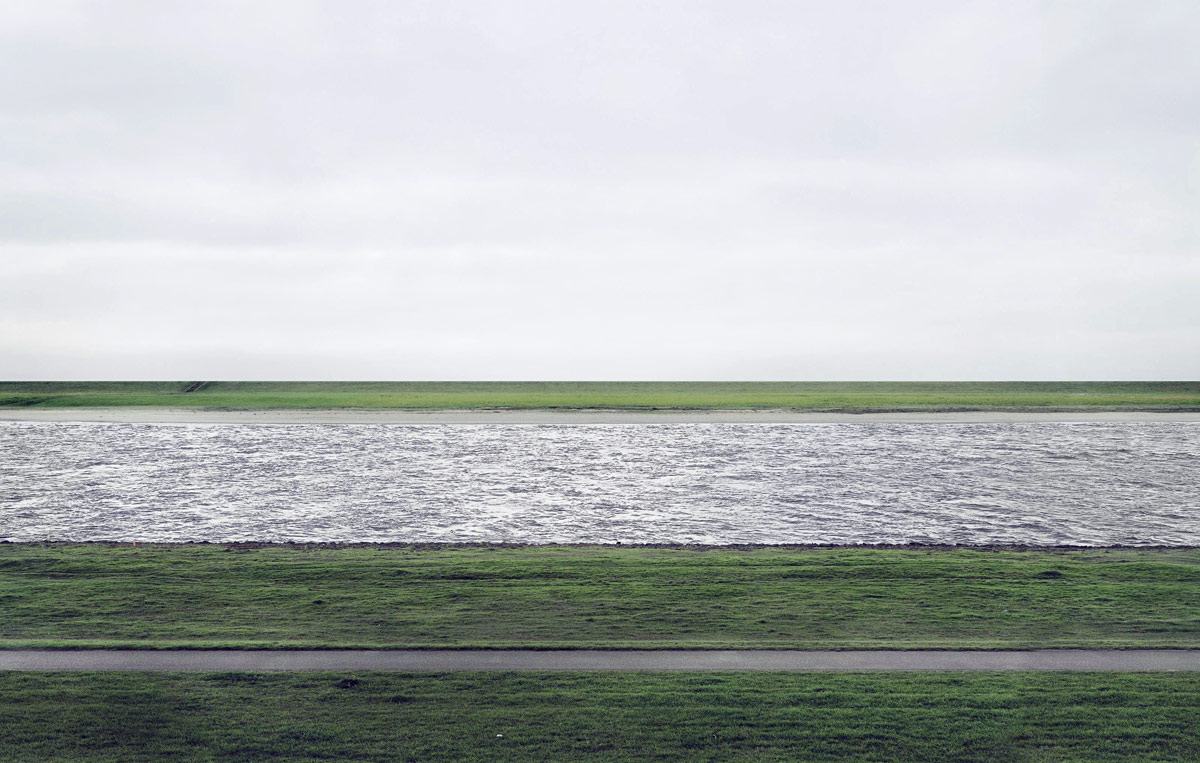
Rhein II
1999
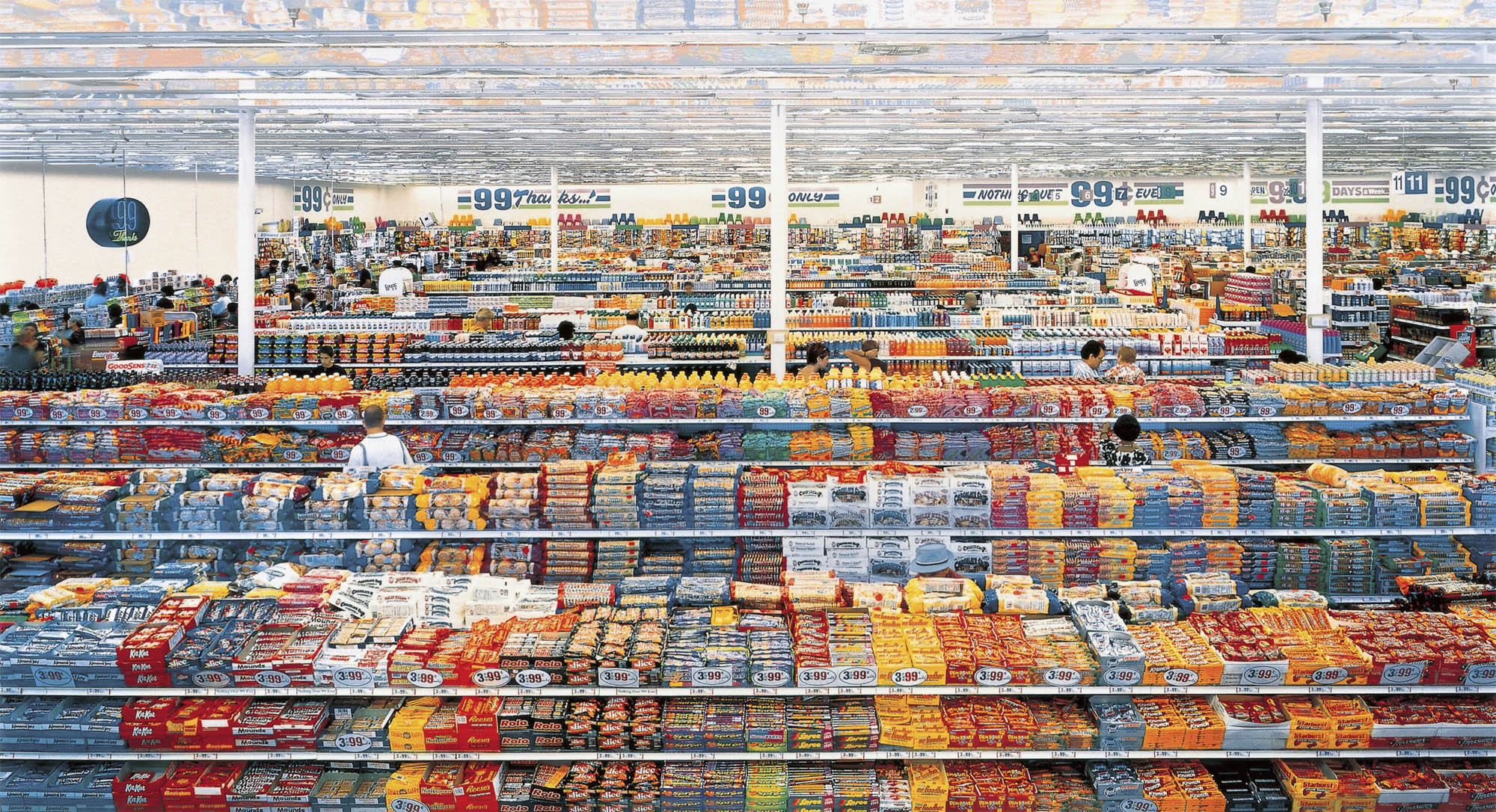
99 Cent II Diptychon
2001
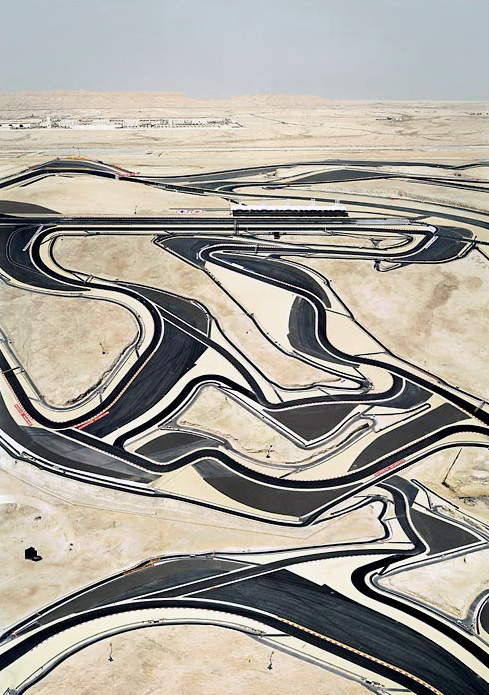
Bahrain I
2005
The German photographer whose monumental, digitally composed images of globalised spaces — stock exchanges, supermarkets, raves, rivers — have redefined the scale and ambition of contemporary art photography.
Born 1955, Leipzig, Germany — German
Rhein II
1999
99 Cent II Diptychon
2001
Bahrain I
2005
Andreas Gursky was born on January 15, 1955, in Leipzig, in what was then East Germany, into a family of commercial photographers. His father, Willy Gursky, ran a successful advertising photography studio, and the young Andreas grew up surrounded by the tools and processes of the medium. The family moved to West Germany during his childhood, settling in Düsseldorf, the Rhineland city that would become the centre of his artistic life. He studied at the Folkwang University of the Arts in Essen before enrolling at the Kunstakademie Düsseldorf in 1981, where he became a student of Bernd and Hilla Becher, the husband-and-wife team whose rigorous typological studies of industrial architecture had established the conceptual and aesthetic foundations of what would become known as the Düsseldorf School of photography.
The Bechers' pedagogy emphasised objectivity, serial approach, and the suppression of individual expression in favour of systematic description. Their students — who included Thomas Struth, Thomas Ruff, Candida Höfer, and Axel Hütte — would go on to become the most commercially successful and critically acclaimed generation of art photographers in history. Gursky absorbed the Bechers' commitment to large-format precision and analytical distance, but from the outset his work diverged from theirs in critical ways. Where the Bechers confined themselves to the typological documentation of specific architectural forms, Gursky was drawn to broader, more complex scenes — landscapes, interiors, and gatherings of people — that resisted typological classification and demanded a different kind of visual intelligence.
Gursky's early work in the 1980s consisted of relatively modest colour photographs of landscapes, swimming pools, and everyday scenes in which an elevated or distant viewpoint and a flattened perspective created images that hovered between documentary and abstraction. These early photographs already displayed the formal characteristics that would define his mature work: a preference for elevated vantage points, an all-over compositional structure in which no single element dominates, and a tension between the photographic image as a record of a specific place and the photographic image as an autonomous aesthetic object.
The decisive transformation in Gursky's practice came in the early 1990s, when he began to embrace digital manipulation as an integral part of his working method. Using computer technology to combine, alter, and extend his photographic source material, he created images of unprecedented scale and visual density. His photograph Montparnasse (1993), depicting the enormous housing block in Paris, was among the first works in which digital stitching and adjustment were used not to deceive but to intensify the viewer's experience of a real place. The image presents the façade of the building as a vast grid of individual windows, each revealing a fragment of domestic life, the whole achieving a monumental scale and visual impact that no single unmanipulated photograph could deliver.
Through the 1990s and 2000s, Gursky produced the series of large-scale photographs that established him as one of the most important and commercially valuable artists of his generation. His subjects were drawn from the landscapes of globalised capitalism: stock exchanges, factory floors, supermarket interiors, hotel lobbies, rave venues, Formula One circuits, and container ports. In each case, the elevated vantage point and the uniform sharpness across the entire image surface created a totalising vision that seemed to encompass the entire system rather than any individual within it. Human figures, when present, were reduced to elements in a larger pattern, their individuality dissolved into the collective structures of consumption, production, and spectacle.
The most celebrated and debated of Gursky's works is Rhein II (1999), a photograph of the Rhine near Düsseldorf that was digitally altered to remove all buildings, people, and industrial features, leaving only the horizontal bands of water, grass, path, and sky. In 2011, the photograph sold at auction for $4.3 million, at the time the highest price ever paid for a photograph. The sale sparked debate about the nature and value of photographic art, but the image itself — in its radical simplification and its evocation of both the Romantic landscape tradition and the minimalist abstraction of the twentieth century — remains one of the defining works of contemporary photography.
Gursky's more recent work has continued to explore the visual structures of the contemporary world, with subjects ranging from the Amazon fulfilment centres to the North Korean Arirang Games, from ocean surfaces to the interiors of European cathedrals. He has also returned to natural landscapes, producing images of rivers, mountains, and coastlines that bring the same monumental scale and analytical vision to the natural world that his earlier work brought to the built environment. Throughout, his work has been characterised by its formal ambition, its engagement with the tension between photography and painting, and its capacity to make visible the vast, impersonal systems that shape contemporary life.
Andreas Gursky lives and works in Düsseldorf, where he holds a professorship at the Kunstakademie. His photographs, typically printed at scales exceeding two metres in width, are held in the collections of the Museum of Modern Art, the Tate, the Centre Pompidou, and virtually every major museum of contemporary art in the world. He remains one of the most commercially successful living photographers, and his work continues to define the upper boundary of what the photographic medium can achieve in terms of scale, ambition, and visual complexity.
I am not interested in an unusual, often accidental moment. I am interested in a typical state of affairs, something which returns, something I regard as a kind of phenomenon. Andreas Gursky
A digitally simplified view of the Rhine near Düsseldorf, reduced to horizontal bands of water, grass, and sky. Once the most expensive photograph ever sold at auction, it encapsulates Gursky's synthesis of landscape tradition and minimalist abstraction.
A dizzying panoramic view of a discount store interior, its shelves forming a dense grid of colour and pattern that transforms mass consumption into a monumental visual spectacle.
A vast, detailed image of traders on the floor of the Chicago commodities exchange, their colourful jackets forming a vibrant mosaic within the geometric architecture of the trading pit, capturing the visual chaos of global finance.
Born on January 15 in Leipzig, East Germany, into a family of commercial photographers.
Enrols at the Kunstakademie Düsseldorf to study under Bernd and Hilla Becher, joining the most influential photography class of the late twentieth century.
Completes his studies and begins exhibiting his early landscape and interior photographs in German galleries.
Produces Montparnasse, one of the first major works to employ digital manipulation as an integral part of the photographic process.
Major solo exhibition at the Kunsthalle Düsseldorf, consolidating his reputation as a leading figure in the Düsseldorf School.
Produces Rhein II, the digitally simplified river landscape that would later become the most expensive photograph ever sold at auction.
Major retrospective at the Museum of Modern Art, New York, cementing his international reputation.
Produces Kamiokande, photographing the Japanese neutrino observatory in a characteristically monumental image.
Rhein II sells at Christie's for $4.3 million, setting a world record for a photographic work at auction.
Produces Amazon, documenting the vast interior of an Amazon fulfilment centre, continuing his exploration of the visual structures of globalised commerce.
Interested in discussing photography, collaboration, or just want to say hello? I’d love to hear from you.
Contact →