André Kertész was born in Budapest, Hungary, in 1894, the second of three sons in a middle-class Jewish family. His father died when he was fourteen, and the young Kertész was raised largely by his mother and an uncle who encouraged his education but expected him to pursue a practical career. He took a position as a clerk at the Budapest Stock Exchange, a job he found stifling but which provided a steady income. It was during these years that he bought his first camera, an ICA box camera, in 1912, and began photographing the world around him — the parks, streets, and people of Budapest — with a natural, intuitive eye that owed nothing to formal training. He was entirely self-taught, and this absence of academic influence would prove to be one of his greatest strengths.
When the First World War broke out in 1914, Kertész was conscripted into the Austro-Hungarian Army. He served on the Eastern Front and carried his camera with him into the trenches, photographing his fellow soldiers with an intimacy and humanity that set his images apart from the official propaganda of the day. In 1915, he was seriously wounded by a bullet that temporarily paralysed his left hand. During his long convalescence, he continued to photograph, producing images of hospital life and recovery that displayed the quiet empathy and compositional instinct that would define his mature work. These early wartime photographs, rediscovered decades later, are now recognised as among the first truly personal documents of modern warfare.
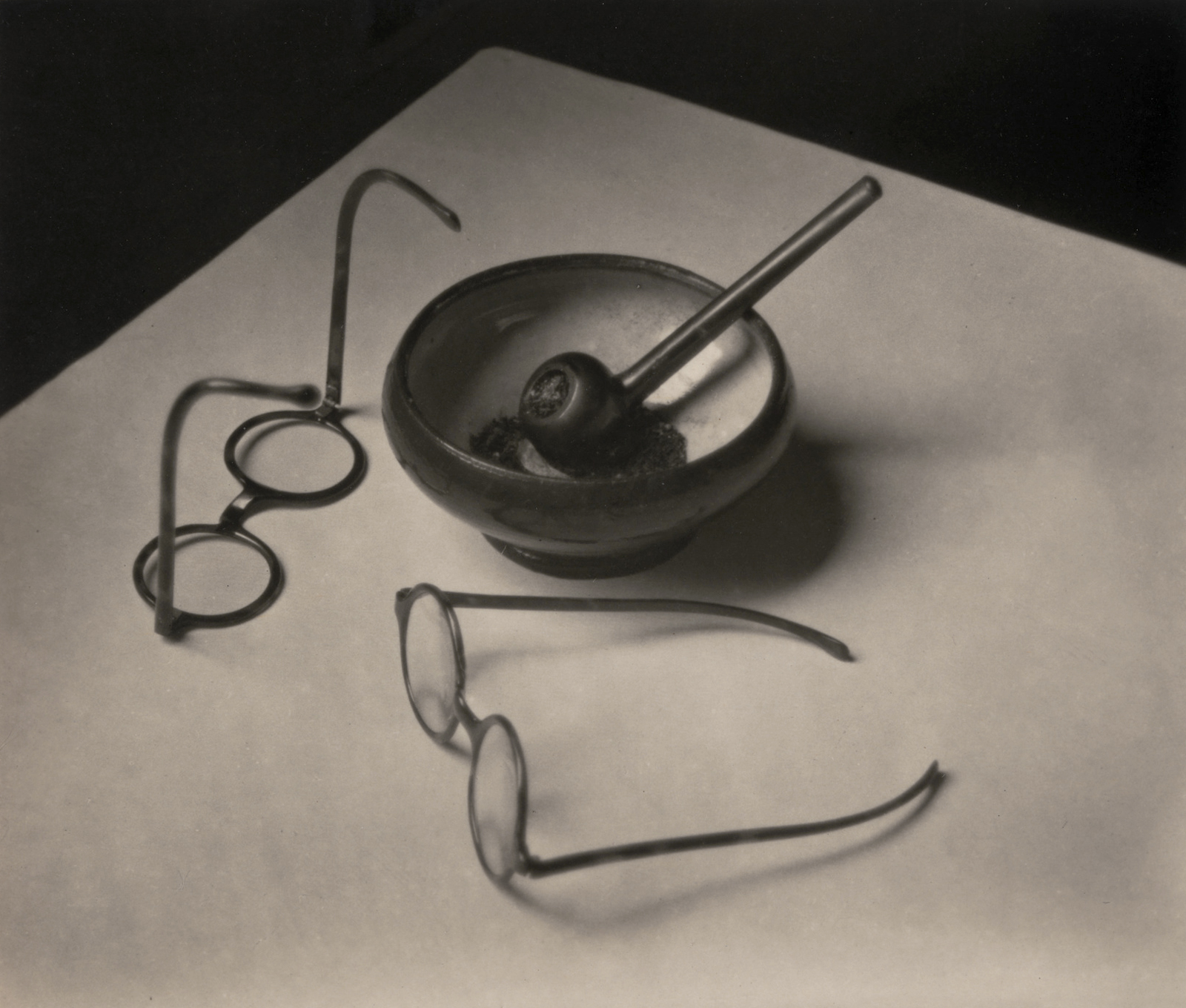
In 1925, Kertész made the decision that would transform his life and career: he moved to Paris. He arrived with little money and few contacts, but within months he had immersed himself in the artistic ferment of Montparnasse. He became friends with Piet Mondrian, whose austere studio he photographed in the iconic Chez Mondrian — a single image of a staircase, a vase of flowers, and the painter's geometric compositions on the wall that has become one of the most reproduced photographs of the twentieth century. He was equally close to Marc Chagall, Sergei Eisenstein, and the circle of painters, sculptors, and writers who gathered in the cafés of the Left Bank. Kertész photographed them all, but he was never merely a portraitist of the famous. His eye was drawn as naturally to a fork resting on a plate, a pair of spectacles on a bench, or the play of shadow on a flight of stairs.
It was in Paris that Kertész pioneered the photo-essay, working for the magazine VU and establishing a model of visual storytelling that would be adopted by Life, Picture Post, and Paris Match. His approach was revolutionary: rather than using photographs as illustrations for a written text, he allowed images to carry the narrative, sequencing them so that each picture built upon the last to create a rhythm and meaning that words alone could not achieve. This innovation — so fundamental that it is now taken for granted — was essentially Kertész's invention, and it transformed photojournalism for the rest of the century.
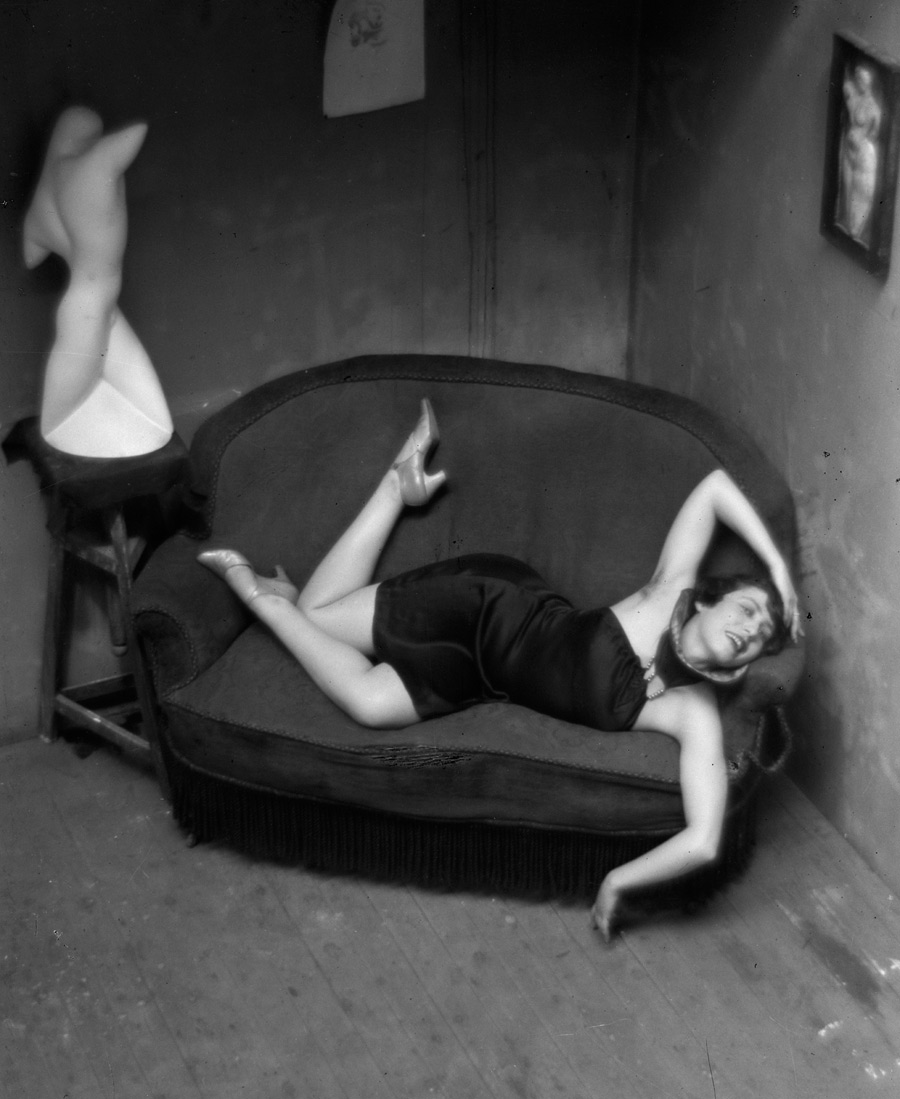
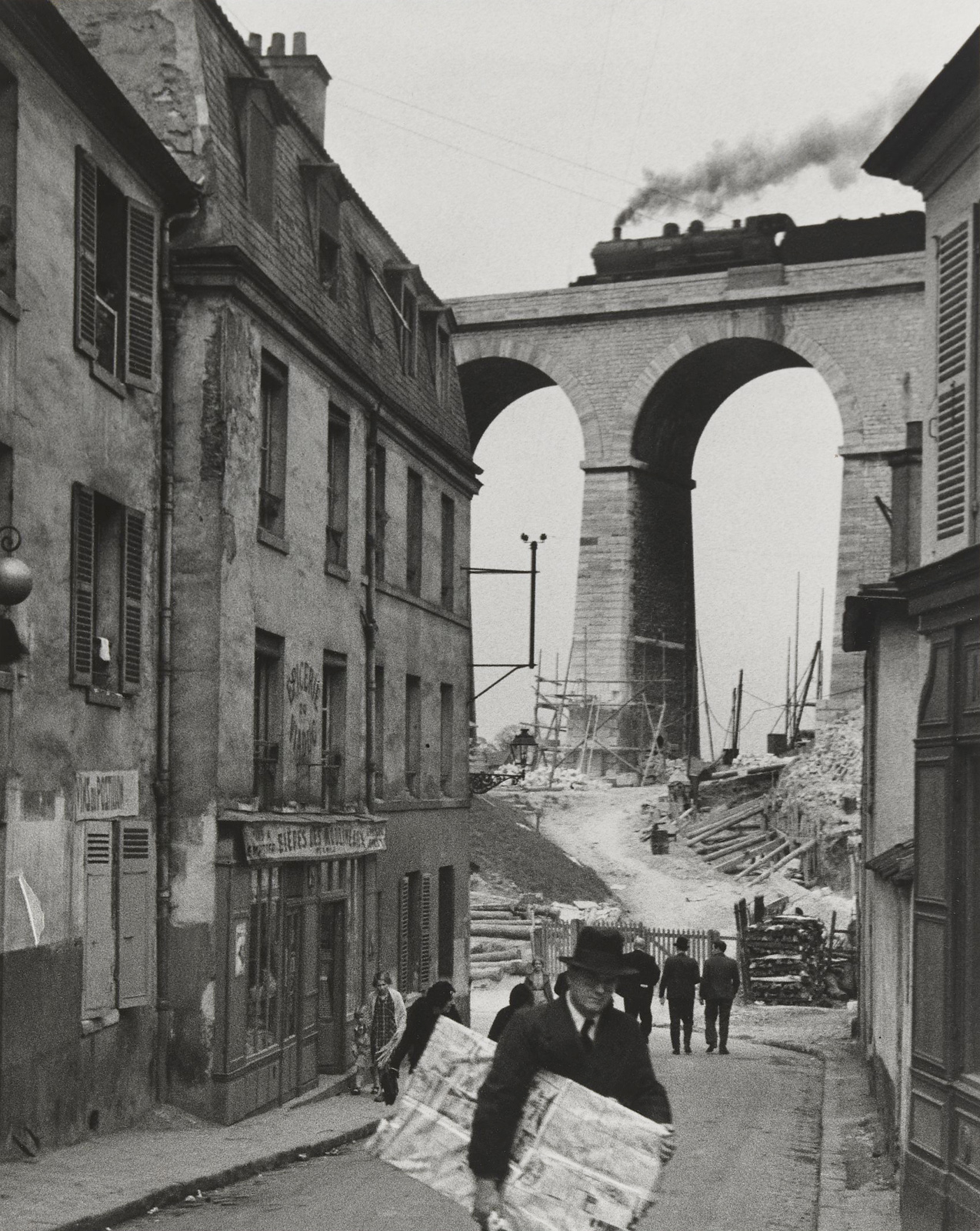
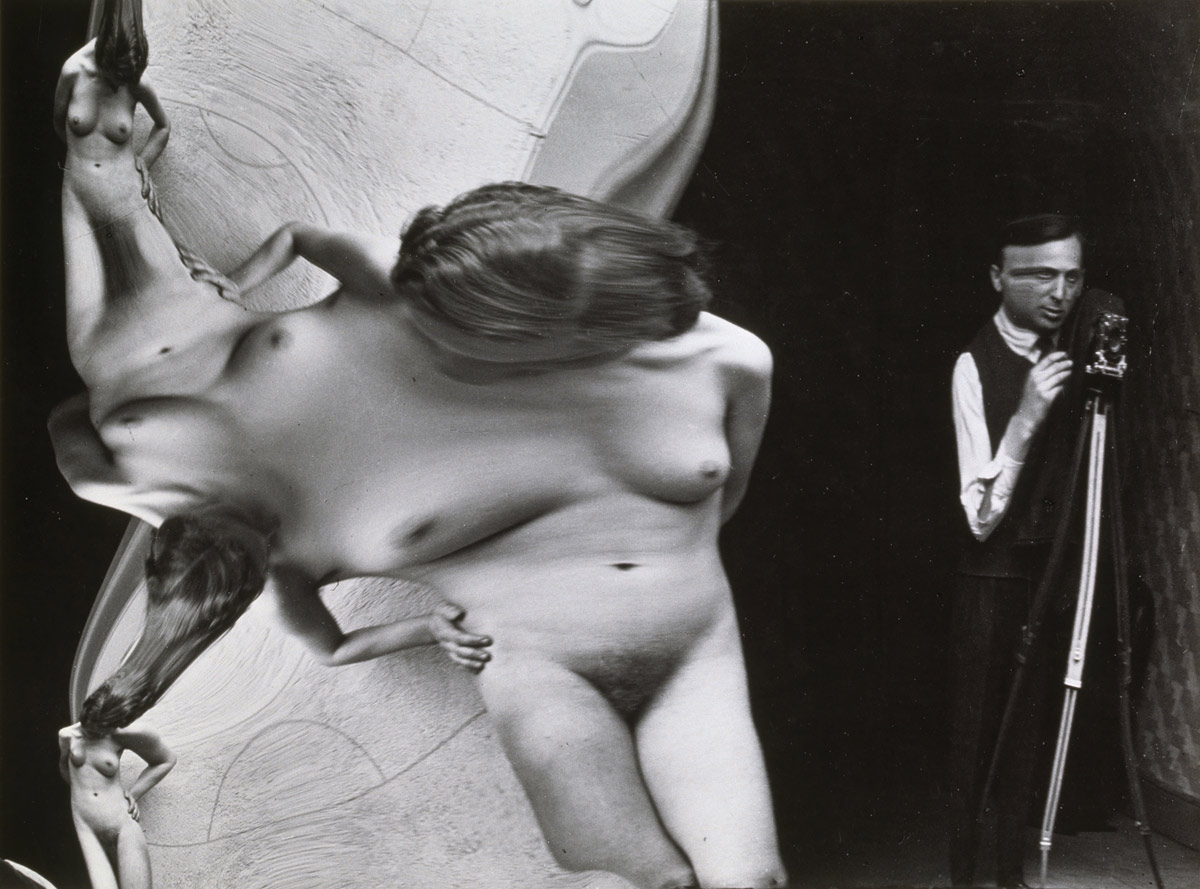
His lyrical eye for form produced some of the most celebrated images in the history of the medium. Fork, Paris (1928) — a simple composition of a fork resting on the edge of a plate beside a bowl — demonstrated his ability to find sculptural beauty in the humblest of objects. The Stairs of Montmartre (1925) captured a solitary figure ascending a steep flight of steps, the geometry of the railings and the curve of the path creating an image of urban poetry. Meudon (1928) showed a man carrying a large wrapped package along a viaduct, a passing train visible below, the entire scene composed with the precision of a painter. In 1933, he created the Distortions series, approximately two hundred photographs of nude figures reflected in funhouse mirrors at a Parisian swimming pool. The resulting images — bodies elongated, compressed, twisted into forms of surreal and sculptural beauty — anticipated Abstract Expressionism and remain among the most inventive works in photographic history.
In 1936, Kertész moved to New York, intending only a brief visit to fulfil a contract with the Keystone Agency. The outbreak of the Second World War trapped him in America, and what was meant to be a temporary stay became a permanent exile. The years that followed were among the most difficult of his life. He found work under contract to Condé Nast, producing photographs for House & Garden and other publications, but the editorial constraints left him deeply unhappy. The lyrical, personal vision that had flourished in Paris was stifled by commercial demands for glossy interior shots and product photography. He felt artistically isolated, unable to pursue the work that mattered to him, and profoundly underappreciated in a country that seemed indifferent to his achievements.
The irony was bitter. While Kertész languished in relative obscurity in New York, the European photographers he had mentored and inspired were being celebrated as masters. Brassaï, who had learned to use a camera from Kertész in Paris, freely acknowledged his debt. Henri Cartier-Bresson, the most famous photographer in the world, said of Kertész: “We all owe him everything.” Robert Capa, born Endre Friedmann in Budapest, had looked to his fellow Hungarian as a model before reinventing himself as the archetypal war photographer. Yet in America, Kertész remained a figure known primarily to other photographers — revered by his peers but invisible to the broader art world.
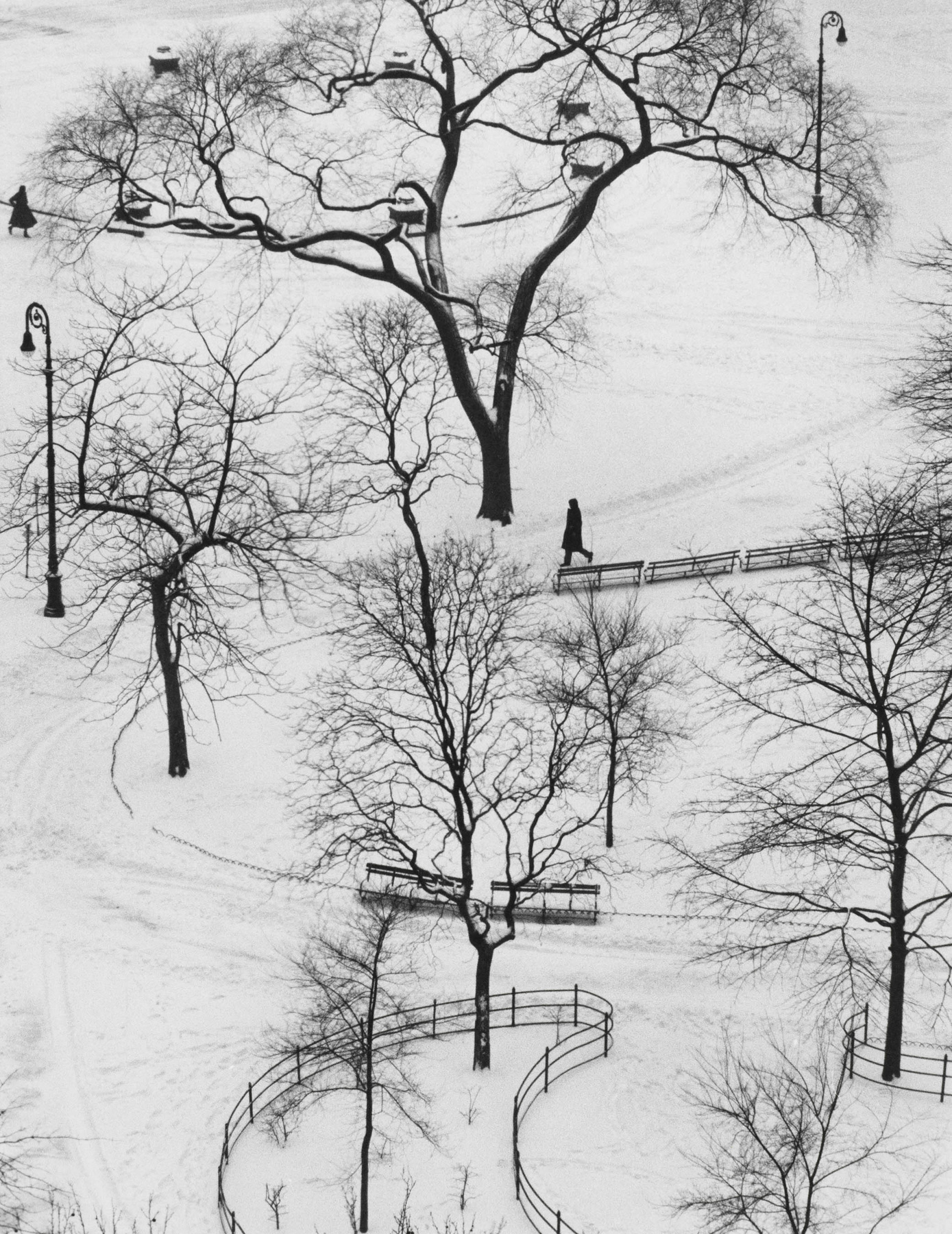
Recognition came late but decisively. In 1964, a major retrospective at the Museum of Modern Art in New York reintroduced his work to a new generation. In the years that followed, exhibitions mounted across Europe and America, and Kertész was showered with honours: the French Grand Prix National de la Photographie in 1977, election as a Commandeur of the French Ordre des Arts et des Lettres, and retrospectives at the Bibliothèque nationale de France. He spent his final years photographing from the window of his apartment overlooking Washington Square Park in Greenwich Village, creating an intimate diary of changing seasons, shifting light, and solitary figures that stands as one of the most poignant bodies of late work in the history of art. He died in New York City in 1985, at the age of ninety-one, finally recognised as one of the most original and influential photographers the medium has ever produced.